Build the Yadadri Landmark in Building Blocks: Step-by-Step
Quick Answer
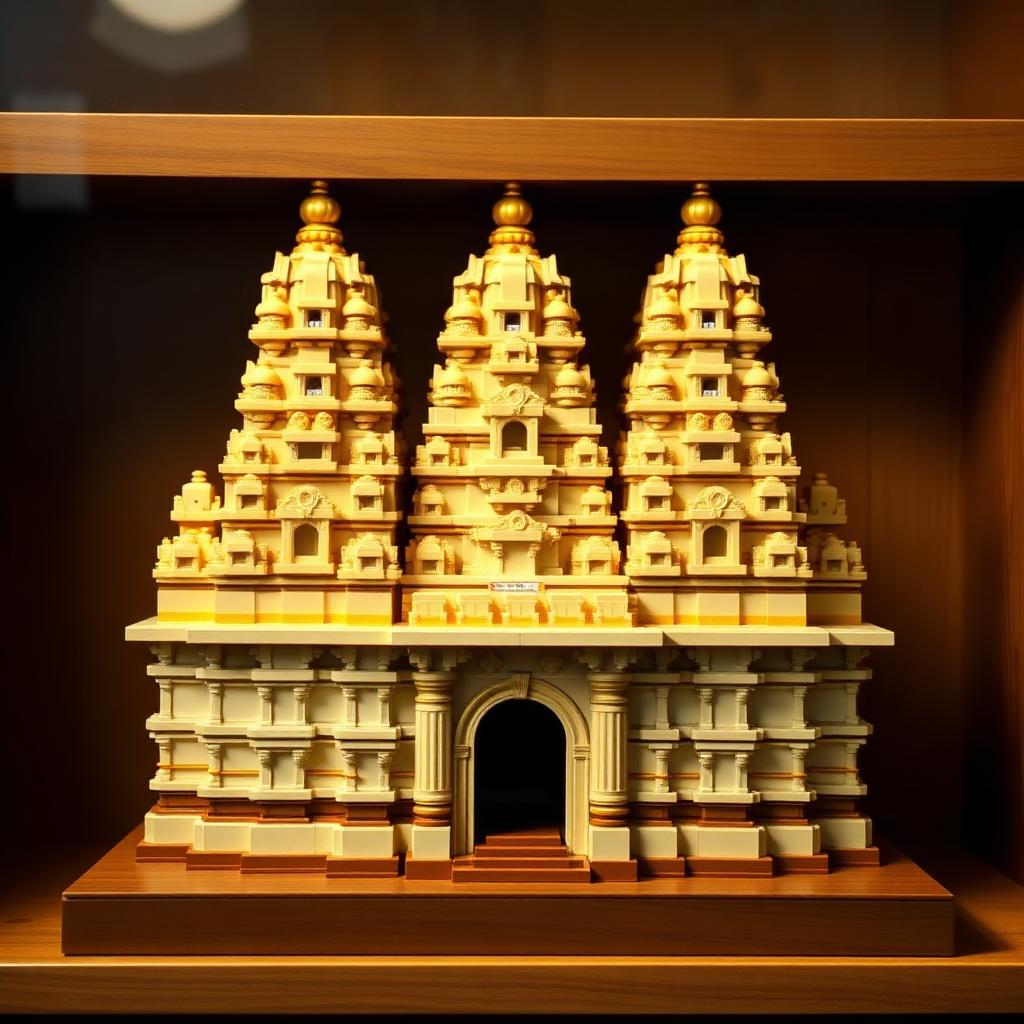
The Yadadri landmark can be recreated in building blocks by following a five-stage process: laying a symmetrical foundation, constructing the tiered base, building the towers and spires, adding decorative detailing, and assembling the final display. The building blocks yadadri landmark 1 set from BrickHobby provides the pieces and guidance to complete this build at home.
There are thousands of famous landmarks that builders recreate in brick form — the Eiffel Tower, the Colosseum, the Taj Mahal. But every so often, a build comes along that feels genuinely different. The Yadadri Temple complex in Telangana, India, is one of those builds. Its layered towers, ornate stone carvings, and multi-tiered base make it a genuinely demanding and deeply rewarding architectural project.
For builders in Europe and North America, this isn't just a novelty build. It's a chance to engage with a piece of living sacred architecture that has been renovated and reimagined in the 21st century. The Yadadri Temple — formally known as Sri Lakshmi Narasimha Swamy Temple — sits atop a rocky hill and features a series of ascending gopurams (gateway towers) decorated with intricate sculptures. Recreating that in brick form takes patience, spatial thinking, and a clear plan.
This guide walks you through everything you need to know. If you're looking for a LEGO alternative that offers the right pieces, piece quality, and community support, BrickHobby is a strong place to start.
What Is the Yadadri Landmark, and Why Does It Make a Great Build?
The Yadadri Temple complex is located in Yadadri Bhuvanagiri district, Telangana, India, about 60 kilometres from Hyderabad. The temple is dedicated to Lord Narasimha, an avatar of Vishnu, and is one of the most significant Hindu pilgrimage sites in South India.
The site underwent a large-scale renovation between 2017 and 2023, when the Telangana state government invested in an extensive restoration of the temple's architecture. The renovation drew on traditional Dravidian architectural styles — the same traditions that produced the great temples of Tamil Nadu and Karnataka.
For brick builders, that combination is exactly what makes it compelling. Dravidian temples are characterised by their gopurams — tall, pyramidal towers that taper toward the top and are densely covered with sculpted figures. Recreating even a simplified version in brick form requires you to think about:
- Symmetrical, stepped profiles that narrow as they rise
- Repeated decorative units (like pillar motifs and arch frames)
- A strong, stable base that can support vertical height
- Colour choices that reflect the gold, white, and ochre tones of the real structure
This is exactly the kind of project that rewards intermediate and advanced builders. If you enjoy this kind of architectural challenge, our reference architecture brick modeling guide covers the planning mindset in more depth.
What You'll Need: Tools, Pieces, and Preparation
Before you place your first brick, a little preparation goes a long way.
Pieces and Materials
The building blocks yadadri landmark 1 configuration requires a specific combination of brick types:
- Flat plates (1x2, 2x4, 2x8) — for layering the base and tiered sections
- Standard bricks (1x1, 1x2, 2x4) — for structural walls and towers
- Slope and wedge bricks — essential for the tapering profiles of the gopuram towers
- Arch bricks — for doorways and decorative recesses
- Round/cylindrical bricks — for pillar details and column accents
- Tile pieces (1x1, 1x2, 2x2) — for smooth, finished surfaces
- Colour palette: primarily cream/tan, gold-yellow, and white — with accents in terracotta and dark brown
If you're sourcing pieces through a LEGO alternative platform, BrickHobby ships to 40+ countries from EU and US warehouses and offers a lifetime brick replacement promise.
Tools and Workspace
- A large, flat baseplate (at minimum 48x48 studs)
- A brick separator tool
- Good overhead lighting
- Printed or digital reference images of the Yadadri Temple
- A sorting tray or containers for organising bricks by type and size
Sort your bricks before you begin. Group them by type, not colour. It saves significant time during the build.
Step 1: Laying the Foundation
The Yadadri Temple sits on a raised rocky platform, and your brick build should reflect that. Start with a solid base layer across your full baseplate.
- Use 2x8 and 2x4 flat plates to create a filled foundation across the entire base area
- Define the outer boundary using a single row of 1x2 bricks laid on their side to create a low perimeter wall
- Mark the centre axis with a row of contrasting-coloured tiles — this line helps you maintain symmetry as the build rises
Aim for a base footprint of approximately 40 studs wide by 28 studs deep on a standard baseplate.
Step 2: Building the Base Structure
The temple's lower body features a series of horizontal bands — plain wall, then pillar-like details, then another plain section. Replicate this by building in layers.
- Lay 3 rows of cream/tan standard bricks across the full width of the base for the main plinth
- Add a row of 1x1 round bricks at regular intervals (every 3-4 studs) to simulate column detailing
- Place tile pieces flush against the wall between columns for a smooth, finished look
- Build up the central raised platform using additional flat plates stacked centrally
Step 3: Constructing the Towers and Spires
This is the most technically demanding part of the build. The gopuram towers are the defining visual element of any Dravidian temple.
Start with the main central tower (the tallest structure, directly above the sanctum):
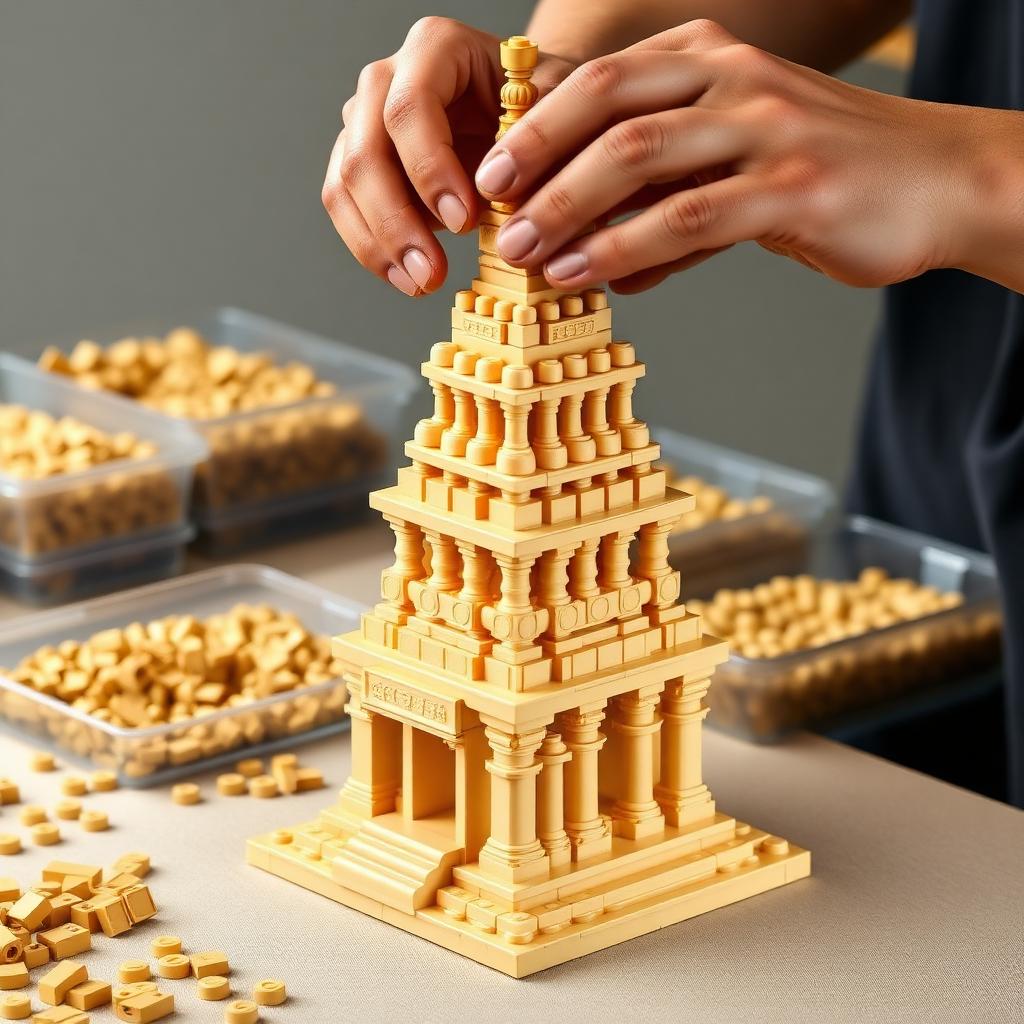
- Build the tower in stages, reducing the width by 1 stud on each side every 4-5 rows as you rise
- Use slope bricks at the corners of each tier to create the pyramid-like taper
- Alternate rows of standard bricks and tile-topped flat plates to break up the surface texture
Then build the secondary towers (typically two flanking towers at the main entrance gopuram):
- These follow the same tapering method but are shorter — roughly 60-70% of the main tower's height
- Keep them symmetrical by counting studs carefully from your central axis marker
At the very top of each tower, use small slope bricks and 1x1 round tiles to form the pointed finial (kalasam). Replicate the gilded original with gold or bright yellow 1x1 round pieces. Builders coming from software or systems design will recognise the modular-tier logic — the same principle we cover in our software architecture MOC guide.
Step 4: Adding Decorative Details
This is where your build transforms from a structural model into something genuinely display-worthy.
Arch frames and doorways: Use arch bricks to define the main entrance on each side of the tower base. A single 1x5x4 arch brick, flanked by 1x1 bricks on each side, creates a convincing gateway opening.
Pillar rows: Along the outer courtyard walls, add regularly spaced 1x1 round bricks stacked 3-4 high, topped with a 1x1 plate. These create a colonnade effect characteristic of South Indian temple architecture.
Surface carvings (simplified): Use 1x1 tiles and 1x1 plates in contrasting colours — dark brown, terracotta, or dark tan — pressed into recessed sections of the wall to simulate sculpted panels.
Colour highlights: Add gold-yellow accent bricks along the top edges of each tier and around the base of each tower finial. Our architecture wooden building blocks guide offers additional detailing techniques that translate well to plastic-brick builds.
Step 5: Final Assembly and Display Tips
Once all major sections are complete, do a final structural check.
- Gently press each tower section from the top to test stability. If anything flexes, reinforce the interior with hidden 2x2 or 2x4 bricks
- Check symmetry from multiple angles — eye level, from above, and from each side
- For display, place the completed model on a large foam board or wooden tray
- A backlit display shelf with warm lighting (around 3000K colour temperature) brings out the gold and cream tones beautifully
- Add a small printed label — "Yadadri Temple, Telangana" — to give the display context
Tips for Customising Your Build
Scale adjustments: For a larger, more detailed version, scale up each section by 50% — doubling the width of each tier and extending the tower height.
Lighting: Many builders add LED strip lighting inside hollow sections. A warm white LED thread inside the main sanctum, escaping through arch doorways, creates a temple-glow effect that's striking in low light.
Courtyard additions: The real Yadadri complex includes surrounding walls, a large water tank (pushkarini), and entry gateways. Extend outward from the main temple using flat plate sections and additional arch bricks.
Colour personalisation: Some builders prefer a stylised interpretation — deep blue and white for a contemporary look, or strictly historical ochre and grey tones. If enterprise-scale planning appeals, see our enterprise architecture building blocks guide for structured approaches.
Why Choose BrickHobby as Your LEGO Alternative
Finding the right source for pieces matters more than it might seem, especially for a landmark build that requires consistent colour across large quantities of bricks.
BrickHobby ships from both EU and US warehouses, so builders typically receive orders within 48 hours. Their bricks use premium ABS plastic with tight clutch — meaning pieces stay together during a tall, gravity-tested build like the Yadadri towers. Colour consistency across batches is reliable, which matters when buying cream and tan bricks in large quantities.
Beyond logistics, BrickHobby offers a lifetime brick replacement promise. If you lose a piece mid-build — and on a complex landmark model, it happens — they'll replace it free.
Their collection spans over 36 architectural models, from the Forbidden City to the Colosseum. For related builds, check the Landmark 5 builder's guide.
Frequently Asked Questions
What skill level is required to build the Yadadri landmark in building blocks?
This build is best suited to intermediate or advanced builders. The tapering tower technique and symmetry requirements are more demanding than a beginner flat-structure build.
How many pieces does the building blocks yadadri landmark 1 project typically require?
A mid-size version — base footprint of roughly 40x28 studs and towers reaching 30-40 studs — typically requires between 1,500 and 2,500 pieces.
Are BrickHobby bricks compatible with standard LEGO pieces?
Yes. BrickHobby bricks use the standard stud system and are fully compatible with LEGO pieces.
How long does this build take to complete?
Most builders complete a mid-size version in 6 to 12 hours of focused building time, spread across several sessions.
What is the best way to display and protect the finished model?
Place the completed model on a stable, flat surface away from direct sunlight. A display case or glass cabinet provides the best long-term protection from dust.
Order LEGO-Compatible Alternatives from BrickHobby
We offer high-quality LEGO-compatible alternative building block sets — including the pieces you need for the building blocks yadadri landmark 1 project. To place an order or ask about specific parts and bulk pricing, please contact our customer service team and we'll help you get started.
Ready to build this yourself?
BrickHobby sells high-quality LEGO-alternative building block sets — the same brick standard, a fraction of the price. Browse our in-stock sets and simply contact our customer service team to place your order; we will confirm availability, pricing and worldwide shipping for you.