
How to Turn Monumental Art Inspiration into Your Most Ambitious Brick Build
Great builds don't start with instructions. They start with an image that won't leave your head.
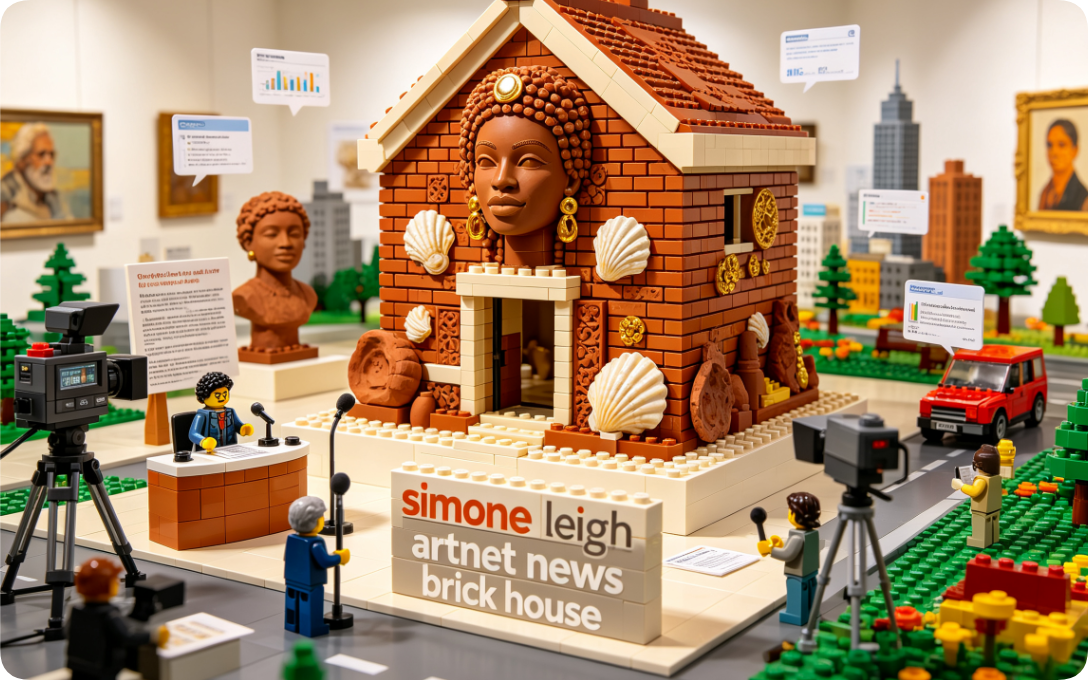
For thousands of builders, that image is Simone Leigh's Brick House: a 16-foot bronze bust of a Black woman, jug-shaped, monumental, and unforgettable. Commissioned as the inaugural sculpture for New York's High Line Plinth and widely covered in the art press, the piece proves a simple point. Scale plus meaning equals impact.
This guide shows you how to translate that lesson into your own brick work. You'll learn how to study a monumental sculpture, break it into buildable forms, plan a large-scale model, and finish it with the kind of intent that separates a shelf-filler from a centerpiece.
No copying. No tracing. Just a repeatable method for turning art that moves you into a build that means something. Let's get into it.
Why Monumental Sculpture Makes a Perfect Build Brief
Most brick sets hand you a finished vision. Sculpture hands you a challenge instead.
The simone leigh artnet news brick house story matters here because it reframes what "ambitious" looks like. The work isn't complex for the sake of showing off. Its power comes from bold form, deliberate proportion, and a clear idea behind every curve. That's exactly the mindset a serious builder needs.
When you use a sculpture as your brief, you commit to three things:
- Form first. You study shape and silhouette before color or detail.
- Meaning first. You decide what the piece is about before you place a brick.
- Scale with purpose. You build big because the concept demands it, not because you have spare parts.
For adult hobbyists chasing a real challenge, this approach turns a weekend project into a genuine design exercise. You stop assembling and start composing.
Quick takeaway: A sculpture gives you a brief with no instructions. That constraint is where your best work happens.
Step 1: Study the Source Like a Designer
Before you touch a single brick, become a student of the piece.
Pull up multiple reference images. The coverage around the simone leigh artnet news brick house commission is useful precisely because it shows the sculpture from many angles, in context, at real scale against people and skyline. That range teaches you how a monumental form reads in the round.
Break the form into primitives
Every complex shape reduces to simpler ones. Train your eye to see them:
- Identify the master silhouette. Squint at the reference. What basic shape dominates? For a jug-form bust, it's a rounded cylinder tapering into a dome.
- Spot the secondary volumes. Note how smaller forms attach to the main mass.
- Mark the focal point. Every strong sculpture has one area that holds your attention. Find it.
Ask what the piece is saying
Monumental art carries intent. Leigh's work draws on themes of strength, presence, and identity. You don't need to replicate the message, but you do need a message for your own build. Strength? Motion? Stillness? Decide now.
Quick takeaway: Reduce the source to shapes and a single idea. Those two outputs become your entire build plan.
Step 2: Translate Organic Curves into Brick Geometry
Here's the hard part every ambitious builder faces. Bricks are square. Sculpture rarely is.
Bridging that gap is the real skill. Three techniques do most of the heavy lifting.
SNOT construction (Studs Not On Top)
SNOT lets you point studs sideways, forward, or down. This is how you wrap curves around a form instead of stacking flat layers. Use brackets and headlight bricks to change direction, then tile over the studs for smooth surfaces.
Slopes, curves, and wedges
Modern brick systems include a deep library of curved slopes and wedge plates. Combine them to approximate rounded volumes. The trick is patience: build a section, view it from three feet away, adjust, repeat.
The staircase-and-smooth method
For large domed or rounded masses, build a stepped internal core, then clad it with slopes and curved tiles to hide the "stairs." This is how big sculptural builds get their smooth read without a smooth internal structure.
Quality parts matter enormously here. Tight, consistent clutch power keeps angled SNOT sections from drifting apart under their own weight. If you're sourcing curved and specialty pieces for a large project, the BrickHobby shop carries the slope and bracket variety these techniques demand.
Quick takeaway: Curves are an illusion built from clever geometry. Master SNOT, slopes, and stepped cladding, and no shape is off-limits.
Step 3: Plan Scale, Structure, and Stability
A monumental build fails without engineering. The bigger the model, the more physics fights you.
Take a cue from the real sculpture. A 16-foot bronze bust needs an internal armature and a solid base. Your brick version needs the same thinking at model scale.
Design an internal skeleton
Don't build a large form as a hollow shell. Instead:
- Create a load-bearing core running vertically through the model.
- Add cross-bracing at intervals to stop twisting and sag.
- Use plates as tie layers, spanning sections to bond them together like a floor slab.
Get the proportions right
Sketch your model at target size first. Decide on height in studs, then work backward to section sizes. Monumental art lives or dies on proportion, so measure twice before committing hundreds of pieces.
Weight and base
Big builds are top-heavy. Give yours a wide, dense base for a low center of gravity. A stable, weighted foundation keeps a tall bust upright and steady on display for years.
For deeper walkthroughs on structural techniques and staging large models, the BrickHobby blog is worth bookmarking before you start planning.
Quick takeaway: Engineer from the inside out. A hidden skeleton and a heavy base are what let a big build stand tall.
Step 4: Choose Color and Surface With Intent
Color is a decision, not a default.
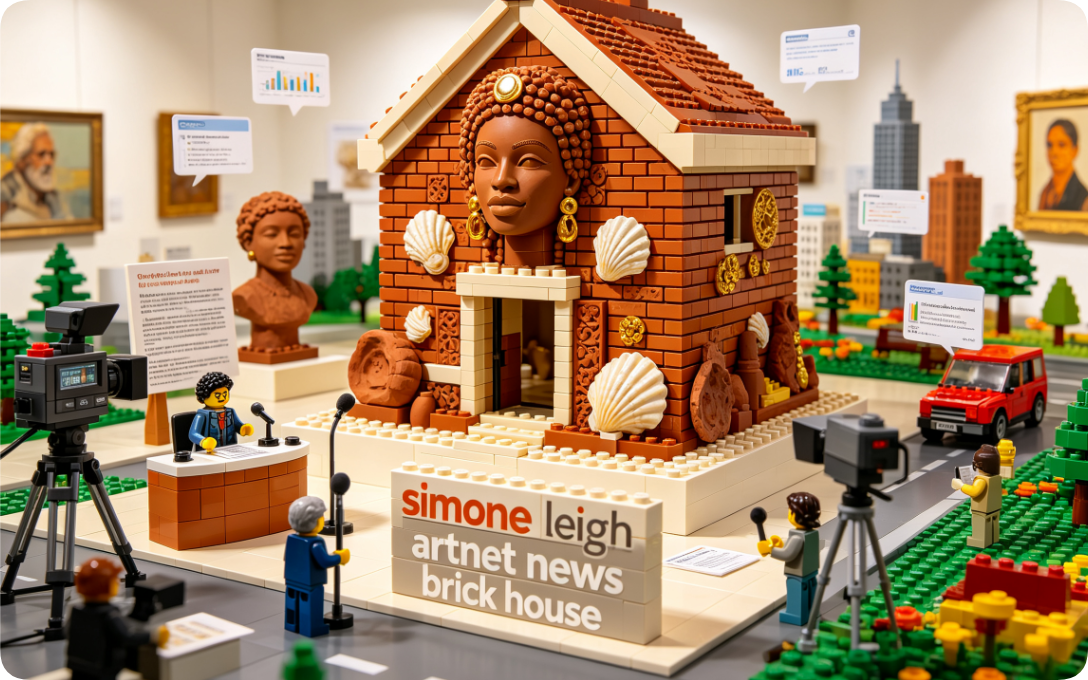
The original simone leigh artnet news brick house works in monochrome bronze, and that restraint is a lesson. A single, considered palette often reads as more sophisticated than a rainbow of parts.
Consider your options:
- Monochrome for gravitas. One color forces the eye to read pure form. Ideal for sculptural, art-forward builds.
- Tonal variation for depth. Use two or three shades of the same color to suggest light, shadow, and volume.
- Texture as surface. Mix tile finishes, exposed studs, and grille pieces to give a flat color visual interest.
Surface finishing tips
- Tile smooth areas to remove the stud grid where you want a polished read.
- Leave studs exposed where you want texture or a nod to the brick medium itself.
- Blend shades on curves to fake soft lighting, hiding odd-tone pieces on interior faces.
Quick takeaway: Restraint reads as intent. Pick a tight palette and let form carry the piece.
Step 5: Build in Sections, Then Integrate
Nobody builds a monument in one pass. Break it down.
Work in modules you can build, test, and refine independently:
- Base module. Build and weight this first. Everything sits on it.
- Core module. The internal skeleton that defines height and stability.
- Cladding modules. The curved outer sections, built in panels.
- Focal module. The face, detail, or feature that holds attention. Save your best pieces here.
Assemble modules only when each one satisfies you on its own. This approach saves you from tearing down finished work to fix a problem three layers down.
Test as you grow
Before you're twenty hours deep, lift and gently flex the growing model. Catch weak seams early. Photograph each stage too. A build log helps you troubleshoot and gives you great content to share later.
Quick takeaway: Modular building lets you perfect each part in isolation, then combine with confidence.
Step 6: Document, Display, and Share
A monumental build deserves an audience. Half the reward of this hobby is the community around it.
Display it properly
- Choose a plinth. A raised base echoes how monumental sculpture is presented and elevates the piece literally and visually.
- Control the background. A dark, neutral backdrop makes form pop.
- Light with intent. Warm, angled light casts shadows that emphasize curves and volume.
Share the process, not just the result
Builders love a good build story. Post your reference study, your SNOT experiments, your structural fixes. Process content sparks more engagement than a single beauty shot.
Join a challenge, enter a community showcase, or simply post your work-in-progress. Feedback from fellow builders will sharpen your next project. To see the full range of brick systems and specialty parts behind ambitious builds like this, explore BrickHobby.
Quick takeaway: Present your build like the art that inspired it, and share the journey to connect with other creators.
Common Mistakes to Avoid
Ambitious builds trip up even experienced hobbyists. Watch for these:
- Skipping the study phase. Rushing to build before understanding the form leads to shapeless results.
- Ignoring the skeleton. Hollow large builds sag and collapse. Engineer the inside first.
- Overcomplicating color. Too many shades muddy the form. Restraint wins.
- Building top-down. Always anchor with a weighted base before you go tall.
- Aligning all seams. Stagger joints like bricklaying so layers lock together.
- Never testing stability. Flex-test as you go. Don't discover a weak core at hour thirty.
If a past big build ended up wobbly or shapeless, revisit your internal structure and your reference study first. Those two fixes solve most problems.
A Quick Framework You Can Reuse
Every monumental build follows the same path. Keep this handy:
- Study the source. Reduce it to shapes and one idea.
- Translate curves using SNOT, slopes, and stepped cladding.
- Engineer an internal skeleton and a weighted base.
- Choose a tight palette with intent.
- Build in modules, then integrate.
- Document, display, and share.
This framework works whether your inspiration is a bronze bust, a cathedral, or a natural landform. The subject changes. The method holds.
Bringing It All Together
The lesson behind the simone leigh artnet news brick house story isn't about copying a sculpture. It's about ambition with intent. Bold form, clear meaning, and engineering that lets scale stand tall.
You now have a repeatable method: study the source, translate its curves, engineer for stability, commit to a palette, build in modules, and share the result. Each step compounds the next, and the finished piece rewards every hour you invest.
Your next moves are simple:
- Pick one monumental artwork that genuinely moves you.
- Reduce it to a master silhouette and a single idea.
- Sketch it at target scale and plan your internal skeleton before you build.
Start there. The most memorable builds always begin with something you couldn't stop thinking about.
Frequently Asked Questions
Do I need to copy Simone Leigh's Brick House exactly to build something inspired by it?\
No. The simone leigh artnet news brick house sculpture works best as a springboard, not a blueprint. Draw on its lessons in scale, bold form, and clear intent, then design something original. Copying a specific artwork raises rights concerns; interpreting its principles into your own creation is where real skill and creativity show.
How many pieces does an ambitious sculptural build usually take?\
It varies widely with size and detail. A tabletop sculptural bust might run 1,000–2,500 pieces, while a large monumental model can climb well past 5,000. Focus on the internal structure and proportion rather than raw piece count. A well-engineered smaller build beats a bloated, unstable large one.
What building techniques matter most for curved, sculptural shapes?\
Three techniques carry most sculptural work: SNOT (Studs Not On Top) for directing surfaces at angles, curved slopes and wedge plates for rounded volumes, and stepped internal cores clad with tiles to smooth the read. Practice each on a small test model before committing to a full-scale project.
Are sculptural builds suitable for less experienced builders?\
Yes, at the right scale. Start with a smaller sculptural form to learn SNOT and slope work, then scale up as your confidence grows. Detailed guides, quality parts, and an active builder community make the jump to ambitious projects far more manageable than it looks.
How do I keep a tall sculptural model from tipping or sagging?\
Engineer from the inside out. Build a load-bearing internal core, add cross-bracing against twisting, use plate tie-layers to bond sections, and give the model a wide, weighted base for a low center of gravity. Flex-test the structure as it grows so you catch weak points early.
Ready to build this yourself?
BrickHobby sells high-quality LEGO-alternative building block sets — the same brick standard, a fraction of the price. Browse our in-stock sets and simply contact our customer service team to place your order; we will confirm availability, pricing and worldwide shipping for you.
Keep reading

Brick News
Track Brick and LEGO Company News Like a Pro Builder
Learn how to track brick and lego company news, spot trends early, and choose better Lego alternatives like BrickHobby for your next build.

Brick News
How to Follow JT the Brick Lego News and Find Better Alternatives
Learn how to track JT the Brick Lego news, spot building trends, and choose the best Lego alternatives for your next build with this practical guide.
Brick News
How to Follow Lego Brick Manufacturer News and Find the Best Alternatives
Learn how to track lego brick manufacturer news and evaluate alternative brands like BrickHobby before your next build. A practical guide for collectors.