Which Giant Building Blocks Are Best for Toddlers? How to Choose, Test, and Play Safely
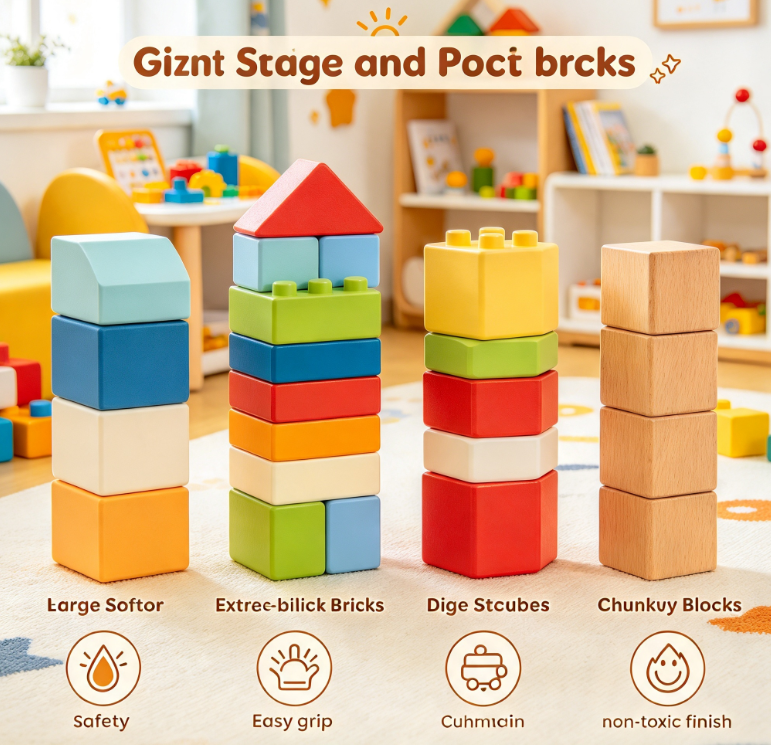
A toddler does three things with a new block. They look at it, bang it on the floor, and put it in their mouth. Usually in that order, and usually within ten seconds.
That's why choosing blocks for a 1- to 4-year-old is so different from buying sets for older kids or adults. Clutch power and piece count matter less here. What matters is whether the block survives teething, throwing, and stomping, and whether it can't be swallowed.
This guide answers which giant building blocks are best for toddlers. You'll get a clear safety checklist, a five-minute home test, a comparison of block types, and age-by-age advice from first birthday to preschool. You'll also learn how to keep a toddler's play space safe when older siblings or parents build with small bricks in the same house.
---
Why Toddlers Need Their Own Kind of Block
Standard bricks are built for fingertips. Toddler blocks are built for whole hands.
A 12-month-old grabs with the palm and fingers together, not with a precise pinch. By around 18 months, many start using a thumb-and-finger grip. Fine control keeps improving through age 4. A block that's too small or too stiff turns play into frustration fast.
Toddler blocks need to handle:
- Mouthing. Toddlers explore with their mouths. Blocks get chewed, sucked, and drooled on.
- Throwing. A block will get thrown. Plan for that.
- Weak pulling strength. Toddlers can push blocks together long before they can pull them apart.
- Short attention. Five minutes of focused building is a real win at 18 months.
- Big feelings. Towers fall. Tears happen. The block should make the next try easy.
Good giant blocks solve all five. The wrong ones fail at least one, and you'll find out which one quickly.
---
Step 1: Learn the Safety Rules Before You Shop
SAFETY FIRST. Every other feature comes second.
Understand the Small-Parts Rule
In the US, toys for children under 3 can't contain parts that fit inside the federal small-parts test cylinder. That cylinder is about 1.25 inches (31.7 mm) wide. The EU uses a matching test under EN 71-1.
What this means for you: Every block, and every piece that could break off a block, must be bigger than that cylinder. Giant toddler blocks should pass easily. Most good ones are 2 inches or more on their shortest side.
Read the Labels Correctly
Labels confuse a lot of parents. Here's what to look for:
| Label or Mark | Region | What It Tells You |
|---|---|---|
| ASTM F963 | US | Meets the main US toy safety standard |
| CPC (Children's Product Certificate) | US | The seller confirms third-party lab testing |
| CE mark + EN 71 | EU | Meets EU toy safety requirements |
| UKCA mark | UK | UK version of the CE safety mark |
| Crossed-out "0–3" symbol | EU/UK | ⚠️ NOT for children under 36 months |
That last one trips people up. The round symbol with a baby face and "0–3" crossed out is a warning, not an approval. It means the toy contains small parts. Don't buy it for a toddler, no matter how big the box looks.
Check the Material
Look for blocks made from food-contact-grade plastics or safe natural materials. Labels like BPA-free and phthalate-free are good signs. Common toddler block materials include ABS, polypropylene (PP), polyethylene (PE), silicone, and solid wood with water-based finishes.
Skip These Features for Under-3s
- Stickers. Toddlers peel them off and eat them. Choose printed or molded designs.
- Loose magnets. Swallowed magnets cause serious internal injuries. Only consider magnetic toys where magnets are fully sealed, and inspect them often.
- Soft foam blocks with thin skins. Teething toddlers can bite off chunks.
- Hard, heavy blocks. Solid hardwood or dense plastic hurts when thrown at a sibling's head.
- Battery compartments without screws. Button batteries are extremely dangerous if swallowed.
---
Step 2: Run the Five-Minute Home Test
Lab standards come first. But a quick check at home tells you how blocks hold up to your toddler. Do this when a new set arrives, and repeat it every few months.
1. The Tube Check
Grab an empty toilet paper roll. Try to push each block through it. If any block, or any part that could break off, slides through, remove it. This is a rough home check only. It doesn't replace certified testing, but it catches obvious problems.
2. The Thumbnail Check
Press your thumbnail hard into an edge or corner. If it leaves a deep dent or tears the surface, a toddler's teeth will do worse. Good blocks shrug this off.
3. The Drop Check
Drop a few blocks from standing height onto a hard floor. Look for cracks, sharp chips, or split seams. Hollow blocks should stay sealed.
4. The Pull Check
Snap two blocks together, then pull them apart. Can you do it with two fingers? Good. If you need real effort, your toddler can't do it at all, and they'll lose interest fast.
5. The Wash Check
Wash a few blocks in warm, soapy water. Dry them fully. Check for faded colors, peeling prints, or water trapped inside hollow pieces. Trapped water can grow mold. Blocks with small drain holes or a sealed design avoid this problem.
QUICK CHECK RESULT: Passes all five? Keep it in the bin. Fails one? Remove that piece.
---
Step 3: Compare the Main Types of Giant Blocks
Parents often ask which giant building blocks are best for toddlers as if one type wins. In practice, the best choice depends on age, and many families use two types side by side.
| Block Type | Best Age | Strengths | Watch Out For |
|---|---|---|---|
| Large interlocking bricks | 18 months–5 years | Stay connected, build tall, grow into bigger projects | Must have easy pull-apart force |
| Soft silicone or rubber stackers | 6–24 months | Safe to chew, quiet, squishy | Don't interlock; limited building |
| Solid wooden blocks | 2–5 years | Durable, great for balance and gravity play | Heavy when thrown; check finish |
| Jumbo cardboard "brick" blocks | 2–4 years | Light, big, great for walls and forts | Crush easily, can't be washed |
| Foam blocks | 2 years+ with supervision | Light and soft | Bite-off risk for teething toddlers |
| Sealed magnetic tiles | 3 years+ | Fun shapes, easy to connect | Must check for cracks and loose magnets often |
Why Large Interlocking Bricks Stand Out
For most families, large interlocking bricks are the core of a toddler collection. Here's why:
- They stay together. A tower that doesn't collapse when touched builds confidence.
- They're double-scale. Most toddler bricks are twice the size of standard bricks in every direction. Many fit the popular double-scale toddler brick system, so they mix with blocks you may already own.
- They connect to the future. On many double-scale bricks, standard-size bricks also snap on top. Older siblings can add details to a toddler's build, and toddlers grow into small-brick building later.
- They're light. Hollow construction means a thrown brick rarely hurts.
Explore large toddler building blocks at brickhobby to compare sizes, colors, and starter set options.
---
Step 4: Check the Features That Matter Most
Once a set clears safety, these details separate a good toddler block from a great one.
Size and Weight
- Size: Aim for blocks at least 2 inches on the shortest side. Bigger is easier for small hands.
- Weight: Light enough that a toddler can carry three or four at once. Light enough that a thrown block doesn't leave a mark.
Pull-Apart Force
This is the most overlooked feature. Toddlers push hard but pull weakly. Blocks should snap on with gentle pressure and come off without a struggle. If your toddler hands you every tower to take apart, the clutch is too tight.
Edges and Corners
Run your hand along the edges. They should be rounded and smooth. No mold lines, no sharp seams. Toddlers fall onto their toys, and corners matter.
Color and Contrast
Bold, clear colors help toddlers tell blocks apart and learn color names. Mix bright primaries with a few softer shades. High contrast also helps younger toddlers whose vision is still developing.
Shapes
A good starter set includes:
- Standard 2x2 and 2x4 bricks (the workhorses)
- A few long bricks for bridges and walls
- Arches or slopes for roofs
- One or two wheel bases (toddlers LOVE anything that rolls)
- A few figures or animal pieces, sized to pass small-parts rules
Skip sets packed with tiny specialty parts. At this age, variety of size and color matters more than variety of shape.
Piece Count
More isn't better here. A first set of 30 to 60 large blocks is plenty for ages 1 to 2. Ages 3 to 4 can handle 80 to 150. Too many blocks turn into a cleanup battle.
Easy Cleaning
Blocks will get sticky. Look for smooth surfaces without deep grooves, and designs that dry fully after washing. Some large plastic blocks handle a mesh laundry bag on a gentle cycle or the top rack of a dishwasher. Always follow the maker's care instructions.
---
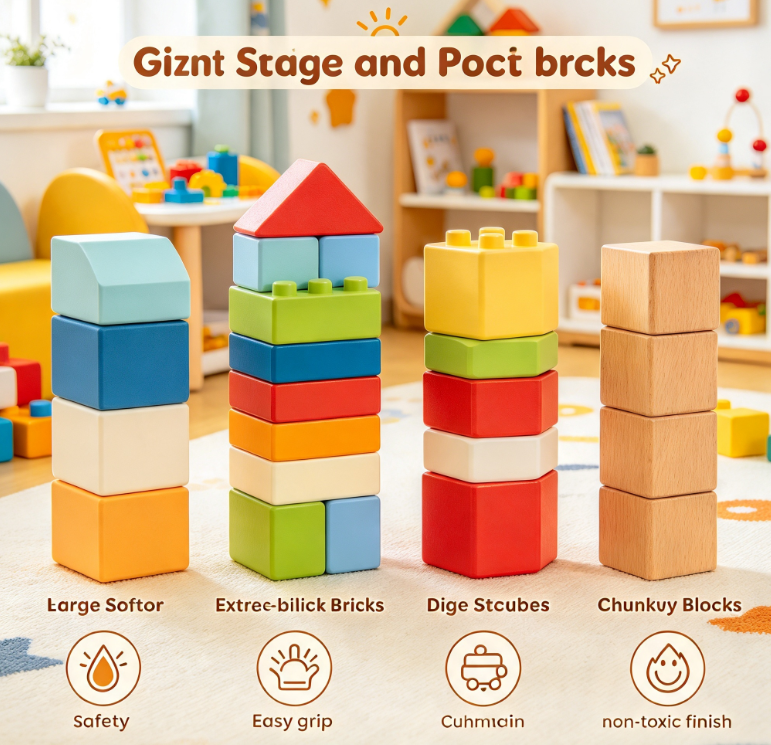
Step 5: Match Blocks to Your Toddler's Stage
Toddlers change fast. A set that bores a 3-year-old can overwhelm a 14-month-old. Use these stages as a guide, not a rulebook. Every child moves at their own pace.
12–18 Months: Explore and Knock Down
What they do: Hold blocks, bang them together, drop them in containers, and knock over anything you build. Some start stacking two blocks.
What to buy:
- Soft stackers or the largest interlocking bricks
- 10 to 20 pieces at a time
- A wide, open container they can fill and dump
How to play: Build a short tower and let them knock it down. Then build it again. Knocking down teaches cause and effect. It's not destruction. It's science.
18–24 Months: First Stacks and Connections
What they do: Stack two to four blocks. Push interlocking blocks together. Start naming colors and objects.
What to buy:
- Large interlocking bricks with light clutch
- 30 to 50 pieces
- A few rolling bases and animal pieces
How to play: Name what you see. "Red block. Blue block. Red on blue." Keep sessions short, five to ten minutes, and follow their lead.
2–3 Years: Towers, Houses, and Pretend
What they do: Build taller towers, simple walls, and enclosures. Pretend play kicks in. A block becomes a phone, a car, or a cake.
What to buy:
- A bigger set of large interlocking bricks, 60 to 100 pieces
- Wooden blocks for balance play
- Figures and animals for stories
How to play: Build homes for toy animals. Make a garage for cars. Ask simple questions: "Where does the dog sleep?" Pretend play builds language faster than almost anything else.
3–4 Years: Plans, Patterns, and Bigger Projects
What they do: Announce what they'll build before starting. Copy simple patterns. Build bridges, ramps, and enclosures with purpose.
What to buy:
- Large brick sets with 100 to 150 pieces, including arches and long pieces
- Sealed magnetic tiles (with supervision and regular checks)
- Jumbo cardboard blocks for forts
How to play: Try pattern games. Build a red-blue-red-blue line and ask what comes next. Build a ramp and test which vehicle rolls farthest. These are early STEM skills: patterns, measurement, and testing ideas.
Find toddler block sets for every stage at brickhobby to grow a collection as your child grows.
---
Step 6: Set Up a Toddler-Safe Building Space
Toddler block play happens on the floor. Set it up for that.
Choose the Right Spot
- Floor, not table. Toddlers build standing, kneeling, and sitting. Give them room to move.
- Soft but firm surface. A low-pile rug or foam play mat works well. Towers stand, and falls don't hurt.
- Away from stairs and furniture edges. Toddlers climb on whatever they build.
Use a Big Base Plate
A large building base plate flat on the floor gives towers a stable start. It turns "my tower keeps falling" into "my tower stays up." For toddlers who are just learning to connect blocks, this one change makes a huge difference.
Rotate, Don't Overload
Keep most blocks in storage. Put out a small amount at a time, then swap pieces every week or two. Toddlers treat a "new" mix of old blocks like a new toy. This also cuts cleanup time.
Make Cleanup Part of Play
Use one wide, low bin. Turn cleanup into a game: "Let's feed the bin all the blue blocks." Toddlers love jobs. Short, playful cleanup builds the habit early.
---
Step 7: Keep Small Bricks Away in a Mixed-Age Home
This is the safety issue most guides skip. Many toddlers live with older siblings, or with parents who build detailed sets as a hobby. Standard bricks and toddler blocks look alike to a 2-year-old. One is safe. The other is a choking hazard.
Create Two Clear Zones
- The Toddler Zone: Floor-level, giant blocks only. Easy to reach and safe to explore.
- The Big Builder Zone: A desk, high table, or room with a closed door. All standard bricks stay here.
Use Visual Cues
Store small bricks in containers with lids, up high. Some families use a colored mat or tape line to mark "big kid" building areas. Toddlers learn boundaries faster when they can see them.
Do a Floor Sweep After Every Big Build
Adults and older kids who build large display models know how pieces escape. A single 1x1 plate can roll under the couch and stay hidden for weeks. After every big-builder session, sweep or vacuum the area. Check under furniture. Run a hand along the rug.
Build Together the Safe Way
Older kids and parents can still build with a toddler. Just use giant blocks together in the toddler zone. Big siblings can design "challenges" for the toddler, like building a tower to copy. Everyone gets involved, and nobody brings small parts onto the floor.
---
Step 8: Know When to Replace or Upgrade
Giant blocks last for years, but not forever. Inspect them every few months.
Replace a block when you see:
- Cracks, splits, or chipped edges
- Deep bite marks
- Faded or peeling prints
- Hollow pieces that let water in or rattle
- Loose or exposed parts on magnetic toys
Upgrade when you see:
- Your child building the same thing every day without interest
- Frustration from too few pieces for bigger ideas
- Interest in finer details and smaller parts
Around age 4 to 5, many kids are ready for smaller bricks, with supervision and the right age rating. Keep the giant blocks. They become forts, ramps, and base structures for years.
---
Quick Buying Checklist
Print this, or screenshot it, before you shop:
- ✅ Labeled for ages 12 months+ or 18 months+ (no crossed-out 0–3 symbol)
- ✅ ASTM F963 (US) or CE + EN 71 (EU) compliance listed
- ✅ Every piece larger than the small-parts cylinder
- ✅ BPA-free, phthalate-free materials
- ✅ No stickers, no loose magnets, no loose batteries
- ✅ Rounded edges and smooth seams
- ✅ Light enough to throw safely
- ✅ Easy pull-apart for little hands
- ✅ Washable without trapping water
- ✅ Right piece count for your child's age
Deciding which giant building blocks are best for toddlers comes down to this list. Tick every box and you've found a strong set.
---
Start Building With Your Toddler
The best toddler blocks are safe to chew, easy to connect, and light enough to throw. They grow with your child from first stacks to pretend play to early STEM games. Start with safety labels. Run the home test. Choose the right type and size for your child's stage. Then sit down on the floor and build together.
🧱 Find your toddler's first set: Shop brickhobby
---
Frequently Asked Questions
Which giant building blocks are best for toddlers under 2?
For children under 18 months, soft silicone stackers and the largest interlocking bricks work best. They're safe to chew and easy to grip. From 18 months to 2 years, large interlocking bricks with a light clutch are the top pick. When parents ask which giant building blocks are best for toddlers this young, the answer is always: big, light, soft-edged, and clearly labeled for under-3 use.
Are giant building blocks compatible with standard bricks?
Many giant toddler bricks use a double-scale design. They connect with other double-scale toddler bricks, and standard-size bricks often snap on top. Check the product details for compatibility before you buy. Never give standard-size bricks to children under 3. They're a choking hazard.
How do I clean toddler building blocks?
Wash them in warm water with mild dish soap, then rinse and air dry completely. Avoid hot water, which can warp plastic. Some large plastic blocks handle the top rack of a dishwasher or a gentle cycle in a mesh bag. Follow the maker's care instructions. Clean more often during cold and flu season or after a sick day.
How many blocks does a toddler need?
Fewer than you'd think. Start with 20 to 50 pieces for ages 1 to 2, and 80 to 150 for ages 3 to 4. Rotate pieces every week or two to keep play fresh without adding clutter.
Is it safe for toddlers to play near older kids' building sets?
Only with clear rules. Keep small bricks in a separate, raised area or a room with a closed door. Store them in lidded containers. Sweep the floor after every big-kid or adult building session. Toddlers can join older siblings safely by building together with giant blocks in the toddler zone.
Ready to build this yourself?
BrickHobby sells high-quality LEGO-alternative building block sets — the same brick standard, a fraction of the price. Browse our in-stock sets and simply contact our customer service team to place your order; we will confirm availability, pricing and worldwide shipping for you.
Keep reading
Kids & Toddlers Bricks
Best Building Blocks for Toddlers 2 Year Old: A Parent's How-To
Your 2-year-old snaps two blocks together, holds them up, and says "Car!" It doesn't look like a car. It doesn't have wheels.
Kids & Toddlers Bricks
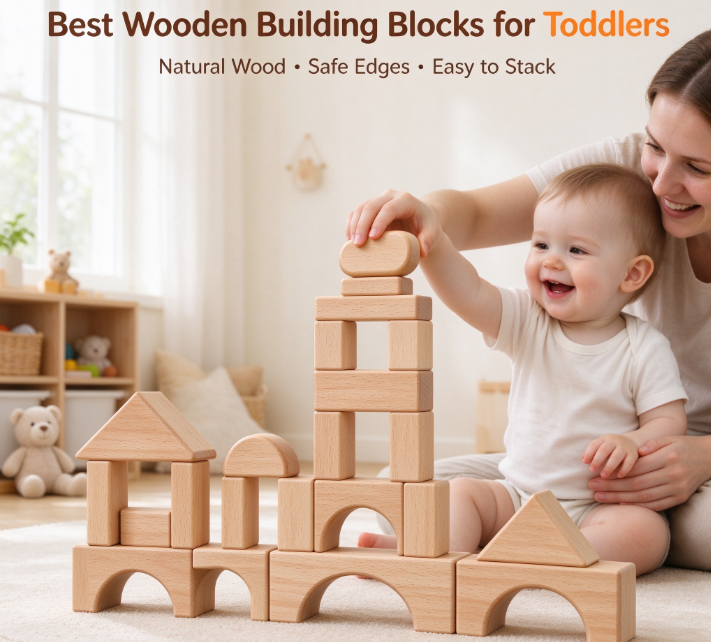
Best Wooden Building Blocks for Toddlers: How to Choose and Use Them
Wooden blocks are the oldest building toy in most homes, and they still earn their spot. No batteries. No app. No pieces that only work one way.
Kids & Toddlers Bricks
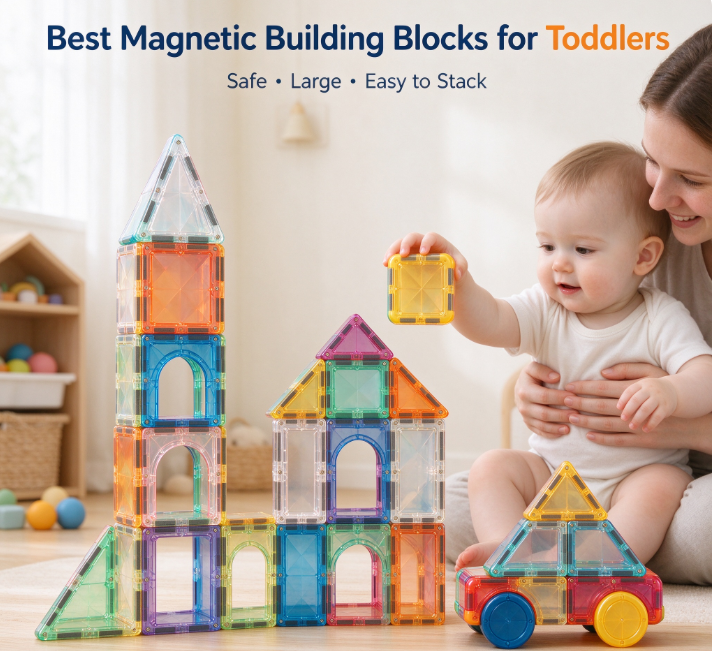
How to Choose the Best Magnetic Building Blocks for Toddlers
Your toddler stacks three tiles. The tower wobbles, then falls. They laugh and start again. That loop is what magnetic blocks are good for.