Best Wooden Building Blocks for Toddlers: How to Choose and Use Them
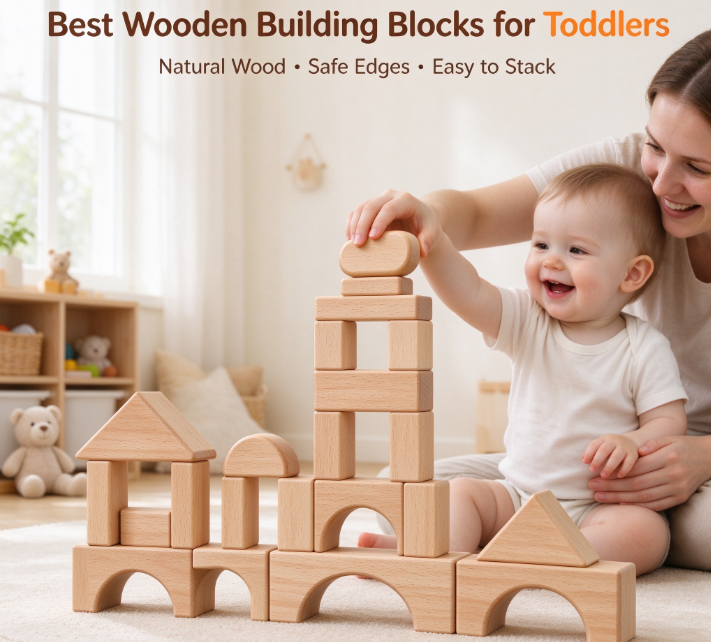
Wooden blocks are the oldest building toy in most homes, and they still earn their spot. No batteries. No app. No pieces that only work one way. A good set outlasts the toddler years, gets passed to younger cousins, and still looks decent on a shelf a decade later.
Shopping for one is harder than it looks. Some sets are made from soft wood that dents on the first throw. Some use paint you wouldn't want near a teething mouth. Some are cut so unevenly that towers lean before your child adds the third block. That gets old fast.
This guide covers how to pick the best wooden building blocks for toddlers and how to use them well once they're home. You'll learn:
- Which wood types hold up and which ones splinter
- How to read paint, oil, and safety labels for the US, EU, and UK
- Why block proportions matter more than piece count
- How to spot the stages of block play and match activities to each one
- How to clean, re-oil, and store a set so it lasts for years
Grab a coffee. By the end, you'll know how to judge any set in under five minutes.
---
Why Wooden Blocks Still Win for Toddlers
Wooden blocks don't snap, stick, or click. That's the point. Your child has to balance each piece by hand, and gravity gives instant feedback. A tower stands or it falls.
That simple loop teaches a lot:
- Balance and weight. A heavy block on top of a small one tips. Toddlers figure this out by trial and error, which is how early physics starts.
- Hand strength and control. Wooden blocks have real weight. Lifting, placing, and lining them up builds grip and wrist control.
- Planning. A wide base holds a taller tower. Kids discover this on their own after enough crashes.
- Open-ended play. A long block is a road today, a bridge tomorrow, and a phone next week.
Wood also feels different. It's warm, a little textured, and it makes a satisfying clack. Many toddlers who ignore plastic toys will sit with a basket of wooden blocks for a surprisingly long time.
Bottom line: Wooden blocks teach balance and planning in a way that click-together toys can't.
---
Step 1: Pick the Right Wood Type
The wood itself decides how long a set lasts. Hardwoods resist dents, chips, and splinters. Softwoods are cheaper but wear faster.
Here's a quick comparison of the woods you'll see most often:
| Wood | Hardness | What to expect |
|---|---|---|
| Maple | Very hard | Tight grain, smooth finish, heavy feel. The classic choice for classroom unit blocks in the US. |
| Beech | Hard | Common in European toys. Pale color, tight grain, very durable. |
| Birch | Medium-hard | Light and smooth. Good for stacking cubes and painted blocks. |
| Rubberwood | Medium-hard | Affordable hardwood from rubber trees after they stop producing latex. Holds paint well. |
| Pine | Soft | Light and cheap. Dents easily and can splinter at the edges. |
| Bamboo | Hard (technically a grass) | Strong, but often made from glued strips. Check that seams are tight. |
What to choose
For toddlers, stick with maple, beech, birch, or rubberwood. These handle drops, throws, and the occasional chew without breaking down.
Pine isn't dangerous on its own, but it marks up quickly. A month of hard play can leave rough edges that need sanding.
A note on rubberwood
Some parents ask about latex allergies. The sap is removed during processing, and rubberwood toys are widely sold as toddler-safe. If your child has a severe latex allergy, ask your pediatrician first and choose maple or beech to be safe.
Look for responsible sourcing
An FSC label means the wood comes from forests managed under the Forest Stewardship Council's standards. It's not a safety mark, but it tells you the brand pays attention to where its wood comes from.
Bottom line: Choose a dense hardwood. It's the single biggest factor in how long your set lasts.
---
Step 2: Check the Finish and Safety Labels
Toddlers mouth everything. The finish on a block matters as much as the wood underneath.
Natural, oiled, or painted?
- Raw or unfinished wood has nothing to flake off. It does stain more easily and can dry out over time.
- Oiled or waxed wood uses food-safe oils or beeswax. It looks warm, resists moisture, and is easy to refresh at home.
- Painted or stained wood adds color. Look for water-based, non-toxic paint. Avoid thick glossy coats that can chip.
Many families like a mix: mostly natural blocks with a few colored ones for sorting games.
Safety standards to look for
Here's what to check on the box or product page:
- United States: The toy should meet ASTM F963, the main US toy safety standard. Under CPSIA rules, children's products are tested by third-party labs, and paint and surface coatings must stay under strict lead limits (90 ppm). Ask the seller for a Children's Product Certificate if it isn't listed.
- European Union: Look for the CE mark and testing to EN 71. Part 1 covers physical hazards like sharp edges and small parts. Part 3 limits how much of certain heavy metals can migrate out of paint and materials.
- United Kingdom: Look for the UKCA mark. CE marking is still accepted in Great Britain for many toys, so you'll often see both.
A trustworthy brand tells you which standards it meets. If a listing just says "eco-friendly paint" with no testing details, keep scrolling.
The small-parts rule
In the US, toys for kids under 3 can't contain parts that fit inside a small-parts test cylinder (about 1.25 inches wide). Most toddler blocks are well above that size. Still, watch for tiny add-ons like pegs, wheels, or decorative pieces in mixed sets.
Bottom line: Pick natural, oiled, or water-based painted finishes, and confirm the set meets ASTM F963, EN 71, or UKCA.
---
Step 3: Understand Block Sizes and Proportions
This is where most buying guides stop too soon. Size and proportion decide what your child can actually build.
What are unit blocks?
Unit blocks are a system first designed for early childhood classrooms in the early 1900s. Every block relates to a basic "unit" in exact ratios. A half unit is half as long. A double unit is twice as long. A quadruple unit is four times as long.
A standard unit block measures about 1⅜ × 2¾ × 5½ inches (roughly 3.5 × 7 × 14 cm). The 1:2:4 ratio means two blocks can stand in for one bigger block perfectly. Walls line up. Bridges fit. Kids learn fractions and measurement by hand, years before they see the words.
Other common block styles
- Stacking cubes (often 1.5 to 2 inches): Easy for babies and young toddlers to grab. Great for first towers.
- Castle or architecture sets: Include arches, cylinders, and triangles. Fun, but tricky for kids under 2.
- Rainbow or arch stackers: Curved pieces that nest together. Beautiful and open-ended, but less useful for structured building.
Why precision matters
Hold two blocks of the same size side by side. They should match exactly. If one is a few millimeters taller, towers lean and walls gap. Cheap sets often skip this step, and toddlers get frustrated without knowing why.
The best wooden building blocks for toddlers are cut to tight tolerances. You can feel it the first time a 10-block tower stands perfectly straight.
Bottom line: Buy blocks that follow a clear size system, and check that same-size pieces really match.
---
Step 4: Run a Five-Minute Quality Check at Home
When a set arrives, test it before you hand it over. Here's the routine.
✅ The hand test. Run your palm over every face and edge. Corners should be rounded or chamfered. Any rough spot or raised grain needs attention.
✅ The splinter test. Rub a soft cloth or nylon stocking across each edge. If it snags, there's a splinter risk. Sand that spot smooth with fine sandpaper (220 grit works well).
✅ The smell test. Fresh wood smells like wood. A sharp chemical or paint odor is a red flag. Air the set out for a few days, and contact the seller if it doesn't fade.
✅ The drop test. Drop one block onto a hard floor from about waist height. Hardwood makes a clean, solid knock and shows no damage. A dull thud and a dent point to soft or low-density wood.
✅ The wipe test. On painted blocks, rub a damp white cloth over a few pieces. Color shouldn't come off on the cloth.
✅ The match test. Stack five same-size blocks. Look at the tower from the side. It should be straight.
If a set fails any of these, reach out to the seller. A good brand replaces faulty pieces without making you jump through hoops.
Bottom line: Five minutes of checking on day one saves you from rough edges and peeling paint later.
---
Step 5: Match Blocks to Your Toddler's Stage
Child development researchers have long noticed that block play follows a fairly predictable path. Kids move through these stages at their own speed, but the order is usually the same. Knowing the stage helps you choose the right blocks and the right activities.
Stage 1: Carrying and exploring (about 12–18 months)
Your child picks blocks up, carries them around, bangs them together, and drops them in containers. There's no building yet. That's normal.
What to offer: 10 to 20 large, lightweight cubes. A basket or bucket for filling and dumping.
Try this: Bang two blocks together, then pause. Wait for your child to copy you. Then do it again with a different rhythm.
Stage 2: Stacking and rows (about 18 months–2 years)
Towers appear. So do long rows on the floor. Many toddlers stack a few blocks around this age, and knocking them down is half the fun.
What to offer: 20 to 40 blocks, mostly cubes and simple rectangles.
Try this: Build a tower together and count each block out loud. Let your child knock it down. Rebuild. Repeat as long as the giggles last.
Stage 3: Bridges and enclosures (about 2–3 years)
Kids start placing one block across two others to make a bridge. They also build "fences" around toy animals and cars. This is a big jump in spatial thinking.
What to offer: A starter unit block set with units, half units, and double units. Add a few toy animals or cars.
Try this: Ask, "The cow needs a barn. Can you build walls around her?" Pretend play gives your child a reason to plan.
Stage 4: Patterns and naming (about 3 years and up)
Builds get symmetrical and decorative. Your child starts naming what they made before or while building: "This is a castle."
What to offer: More unit block shapes, arches, cylinders, and a few colored blocks.
Try this: Build a simple pattern (long, short, long, short). Ask your child what comes next.
Bottom line: Start with carrying and stacking, then add shapes as bridges and enclosures appear.
---
How to Introduce Wooden Blocks the Right Way
The way you introduce blocks shapes how your child uses them for months.
Start with fewer blocks
A pile of 80 blocks can overwhelm a toddler. Put out 10 to 15. Keep the rest out of sight. Swap or add more every week or two.
Build at floor level
Wooden blocks fall. That's part of the deal. A rug or foam play mat softens the noise and protects your floors. A low shelf next to it makes cleanup easy.
Sit down and play
You don't need to lead. Sit nearby, build your own small structure, and narrate. "I'm putting the long block on top." Toddlers copy what they see.
Set one simple rule
Blocks are for building, not throwing. A wooden block thrown at a sibling hurts. Redirect calmly every time: "Blocks stay on the floor. Let's build."
Let crashes happen
Don't rush to save a wobbly tower. The fall teaches more than a rescue. Say, "It fell! Want to try a bigger bottom?"
Bottom line: Small batches, floor-level play, a calm rule about throwing, and plenty of room to fail.
---
Play Ideas That Go Beyond Towers
Once your child is stacking with confidence, mix it up.
- Block roads. Lay long blocks end to end across the room. Drive toy cars along the road. Add a bridge.
- Sound game. Tap blocks of different sizes on the floor. Ask which one sounds louder or deeper.
- Shadow towers. Shine a flashlight on a tower in a dim room. Talk about tall and short shadows.
- Sorting baskets. Sort by shape, then by size, then by color.
- Copy me. Build a three-block structure. Hide it behind your hand, then reveal it and ask your child to copy it.
- Domino rows. Stand blocks upright in a line and tip the first one over. Simple cause and effect, every time.
- Photo gallery. Take a photo of one build each week. Print a few for the fridge. Kids love seeing their work on display.
That last one works for grown-ups too. Plenty of adult builders share their projects online, and kids pick up on that pride.
Bottom line: Add cars, light, sound, and copying games to stretch the value of every block.
---
Clean, Re-Oil, and Store Your Set
Wooden blocks last for decades with basic care. Skip these steps and they dry out, crack, or grow mildew.
Cleaning
- Wipe with a cloth dampened in warm water and a drop of mild soap.
- For a deeper clean, use a mix of one part white vinegar to four parts water.
- Never soak wooden blocks. Never put them in the dishwasher.
- Dry right away and let them air out fully before storing.
Re-oiling
Every few months, or when the wood looks dull, apply a thin coat of food-grade mineral oil or a beeswax-and-oil blend. Rub it in with a soft cloth, wait 15 minutes, and wipe off the extra. Let blocks dry overnight. This keeps the wood from drying and cracking.
Fixing wear
Small dents and rough patches happen. Sand lightly with fine sandpaper, wipe off the dust, and re-oil. Throw out any block with a deep crack or split.
Storage
A low open shelf works better than a toy box. Kids can see every shape and put blocks back where they belong. Some families trace block outlines on the shelf so toddlers can match each block to its spot. That's a sorting lesson built into cleanup.
Keep blocks away from radiators and direct sun. Heat and dry air crack wood over time.
Bottom line: Wipe, don't soak. Re-oil a few times a year. Store on open shelves away from heat.
---
Avoid These Common Buying Mistakes
- Buying the biggest set first. A 100-piece set isn't better for a 15-month-old. Start small and expand.
- Choosing by color alone. Bright paint looks great in photos. Check the wood type and safety testing first.
- Mixing sizing systems. Blocks from different brands often don't line up. Stick with one system when you expand.
- Ignoring weight. Very heavy blocks are hard for young toddlers to lift and hurt when dropped on toes. Size up gradually.
- Skipping the label. No listed standard means no proof of testing. Move on.
Bottom line: Shop by wood, finish, and sizing system, not by piece count or color.
---
From Wooden Blocks to Brick Building
Wooden blocks lay the foundation. Around ages 4 to 6, many kids want more detail. They want doors that open, wheels that turn, and models that look like the real thing. That's when interlocking bricks come in.
The skills carry straight over. A child who learned that a wide base holds a tall tower already understands structure. A child who built barns for toy animals is ready to follow step-by-step instructions for a full model.
BrickHobby makes LEGO-compatible brick sets for that next step. Clear instructions. Builds for every skill level. Sets for kids, families, and adult builders.
Keep the wooden blocks around, though. Older kids still use them for big floor builds, ramps, and helping younger siblings.
Build side by side
If you build brick models as a hobby, set up your project next to your toddler's block area. You work on your model. They work on their tower. Same table, same time. Kids copy what they see, and nothing makes building feel more important than watching a parent do it. Browse brick sets for adult builders if you want a project of your own.
Bottom line: Wooden blocks teach the basics. Brick sets build on them. Many families keep both.
---
Conclusion
Choosing the best wooden building blocks for toddlers comes down to a few clear checks. Pick a dense hardwood like maple or beech. Confirm a safe finish and a listed standard: ASTM F963, EN 71 with CE, or UKCA. Look for a consistent size system with blocks that match exactly. Then test the set at home, introduce it in small batches, and match activities to your child's stage.
Do that, and one set covers years of screen-free play, from the first wobbly two-block tower to full castles with bridges and gates.
When your builder is ready for more detail, explore BrickHobby sets for the next challenge. Start building together!
---
FAQ: Wooden Building Blocks for Toddlers
What age can toddlers start playing with wooden blocks?
Many babies start handling large, lightweight wooden cubes around 9 to 12 months. Stacking usually begins between 18 months and 2 years. Always follow the age label on the box, and pick blocks large enough to pass small-parts rules for children under 3.
Are painted wooden blocks safe for toddlers who chew?
Yes, if the paint is water-based and the set is tested to ASTM F963 in the US or EN 71 in the EU. These standards limit lead and other heavy metals in surface coatings. Check painted blocks often, and remove any piece with chipping or peeling paint.
Which wood is best for toddler building blocks?
Hard maple and beech are the top choices. Both are dense, smooth, and resist dents and splinters. Birch and rubberwood are good, more affordable options. Avoid soft pine for toddlers who throw or chew, since it wears down quickly.
How many wooden blocks does a toddler need?
For kids around 12 to 24 months, 20 to 40 blocks is plenty. Toddlers from 2 to 3 years old benefit from a starter unit block set of 40 to 60 pieces. Classroom-size sets of 100 or more work well for preschoolers and families with several kids.
How do I clean and maintain wooden blocks?
Wipe them with a damp cloth and mild soap, or a diluted vinegar solution. Never soak them or use the dishwasher. Re-oil with food-grade mineral oil or beeswax every few months to keep the wood from drying and cracking.
Ready to build this yourself?
BrickHobby sells high-quality LEGO-alternative building block sets — the same brick standard, a fraction of the price. Browse our in-stock sets and simply contact our customer service team to place your order; we will confirm availability, pricing and worldwide shipping for you.
Keep reading
Kids & Toddlers Bricks
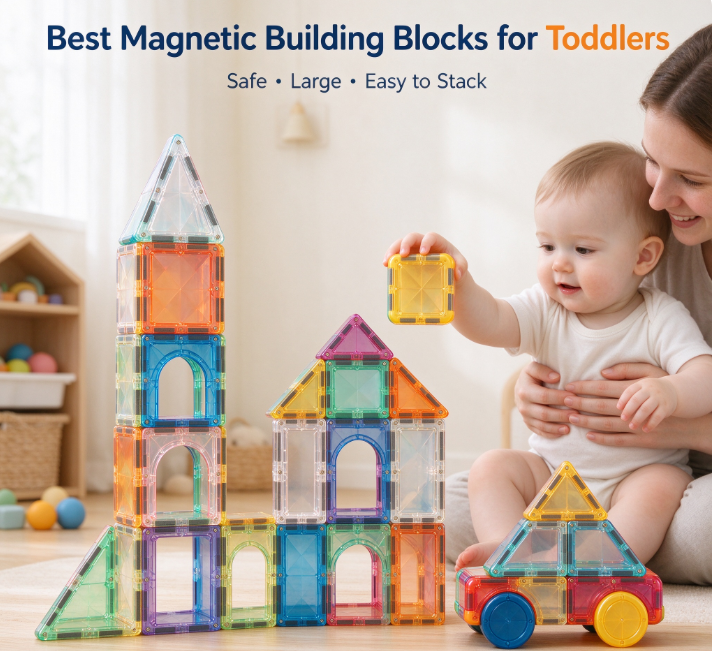
How to Choose the Best Magnetic Building Blocks for Toddlers
Your toddler stacks three tiles. The tower wobbles, then falls. They laugh and start again. That loop is what magnetic blocks are good for.
Kids & Toddlers Bricks
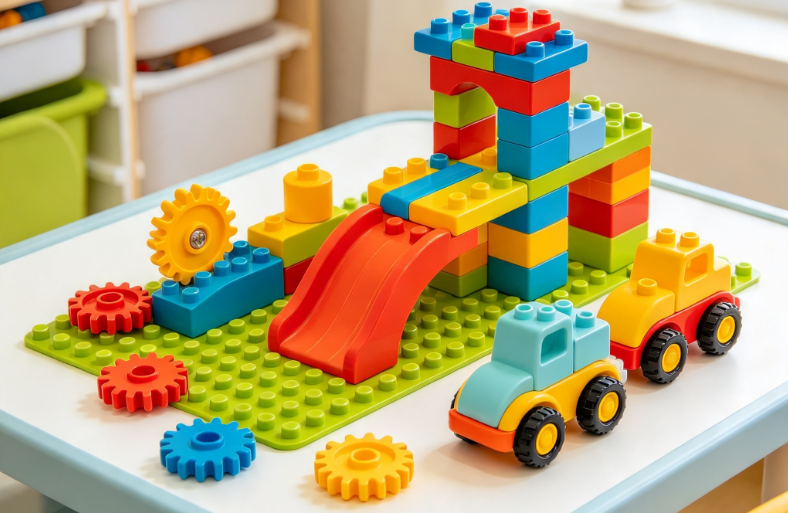
How to Choose and Use the Best Giant Building Blocks for Toddlers
Toddlers don't need complicated toys. They need blocks big enough to grip, safe enough to chew, and sturdy enough to survive a thousand stacking-and-smashing sessions.
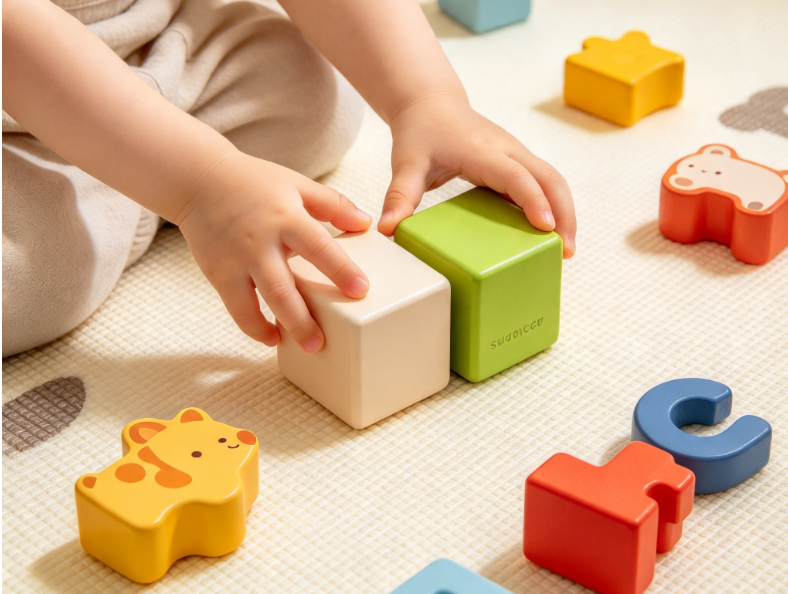
Kids & Toddlers Bricks
How to Choose and Use the Best Giant Building Blocks for Toddlers
Toddlers don't need complicated toys. They need blocks big enough to grip, safe enough to chew, and sturdy enough to survive a thousand stacking-and-smashing sessions.