Best Building Blocks for Toddlers 2 Year Old: A Parent's How-To
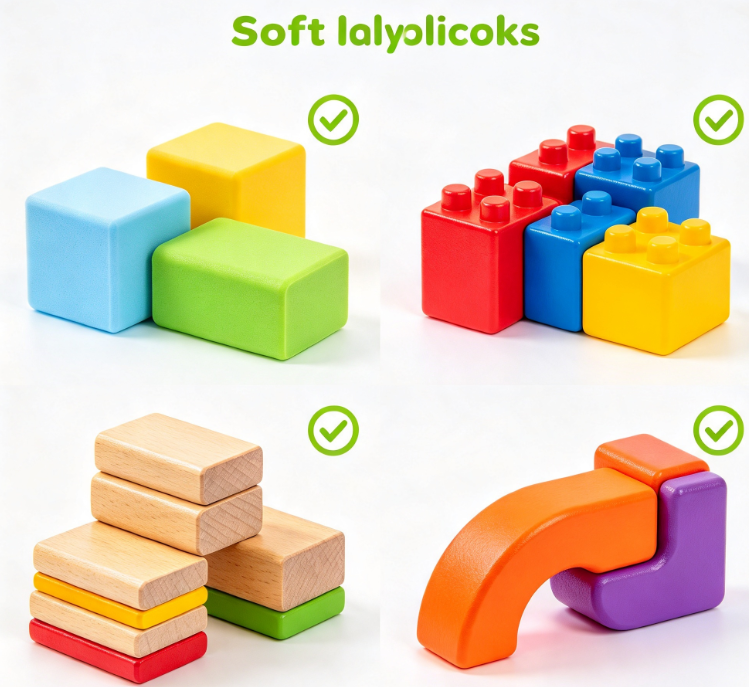
Your 2-year-old snaps two blocks together, holds them up, and says "Car!" It doesn't look like a car. It doesn't have wheels. But in that moment, your child has made a symbol, a plan, and a word all at once.
Age two is when blocks stop being objects to bang and start being tools for ideas. This guide covers best building blocks for toddlers 2 year old buyers should look for, and how to play so those blocks keep teaching for the whole year. It is built around what actually happens between the second and third birthday.
You'll learn:
- What changes in motor skills, language, and thinking at age 2, and what each change means for blocks
- How to pick a set built for color, shape, and pretend play
- Simple co-play strategies that build vocabulary without feeling like a lesson
- Red flags that tell you a set is wrong for this age
---
What Changes at Age 2 (And Why It Matters for Blocks)
Between 24 and 36 months, toddlers grow fast in four areas at once. The right block set supports all four. The wrong one only fits one.
| Development Area | What You'll See Around Age 2 | What It Means for Blocks |
|---|---|---|
| Fine motor | Stronger grip, early thumb-and-finger control, twisting and turning objects | Blocks should press on with a gentle push and pull apart with small hands |
| Gross motor | Walking, squatting, carrying several things at once | Blocks should be light enough to carry in an armful across the room |
| Language | Two-word phrases ("Big truck," "More block"), new words almost every week | Sets need things worth naming: animals, people, colors, vehicles |
| Thinking | Early problem-solving, simple cause and effect, the start of pretend play | Sets need pieces that can "be" something: doors, wheels, figures |
| Social | Mostly playing next to others, not with them yet | Enough pieces for two builders, so nobody has to share every block |
Child development checklists list one milestone that sounds almost too specific. Around two and a half, many children start "feeding" a block to a doll as if it were food. That's pretend play. One object stands in for another. It's also the foundation for reading, math, and storytelling later on.
So what? The best set for a 2-year-old is not just "big blocks." It's big blocks plus things to pretend with.
---
Step 1: Match the Block to 2-Year-Old Hands
A 2-year-old has more control than a baby, but much less than a preschooler. Blocks need to sit right in that gap.
What "Right Size" Looks Like at Two
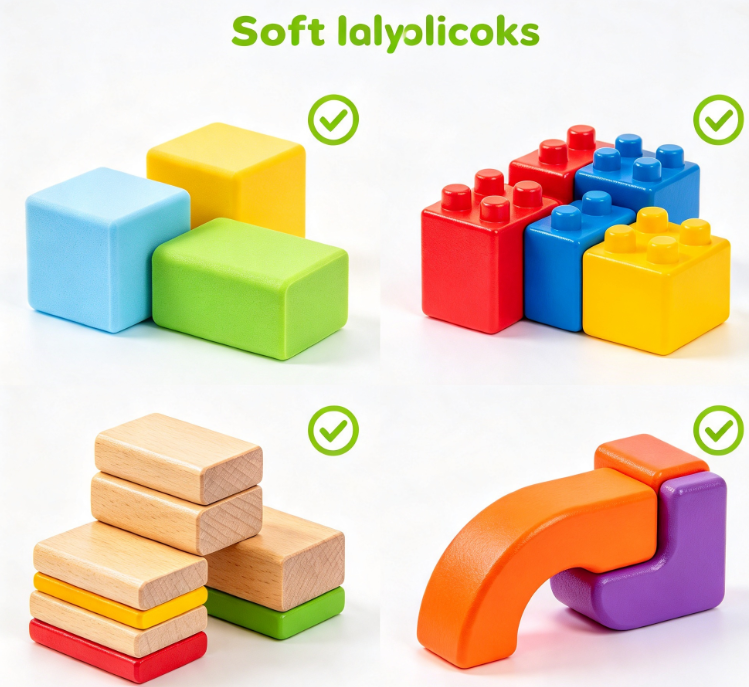
Double-scale interlocking bricks are the sweet spot for most 2-year-olds. They're large enough for a palm grip and light enough to stack high without the tower crushing itself. Standard-size bricks are too small and too stiff for this age, and they're a choking hazard for children under 3. Keep them out of the toddler set entirely.
Clutch Strength: The Detail Most Parents Miss
Here's the pattern at age 2. Your child pushes blocks together easily. Then they try to take them apart, fail, and hand you every single tower.
That's a clutch problem, not a skill problem. A good set for this age has:
- Soft-snap connection. Blocks hold when stacked but release with a gentle twist.
- Forgiving alignment. Blocks still connect when they're slightly off-center.
- Tall, not tight, studs. Studs guide the block into place, so lining up isn't a fight.
PARENT TIP: Watch your child for one session. If they ask for help pulling apart more than twice, the clutch is too strong for now.
Weight Matters More Than You Think
Two-year-olds love to carry. They load their arms, walk to the other side of the room, and dump everything in a pile. Hollow plastic bricks make this easy. Heavy solid blocks make it tiring, and your child gives up on the "moving day" game that builds gross motor skills.
---
Step 2: Pick a Set Built for Color and Shape Learning
Most 2-year-olds can't reliably name colors yet. That surprises a lot of parents. Color learning usually goes in three stages:
- Match. "Find another one like this." (Often starts around age 2)
- Point. "Show me the blue one."
- Name. "What color is this?" (Often closer to 3)
Blocks are perfect for stage one and stage two. So choose a set that makes matching easy.
Choose a Clear Color Palette
| Palette Type | Good for Age 2? | Why |
|---|---|---|
| 4–6 bold primary colors (red, blue, yellow, green, plus white or orange) | ✅ Yes | Easy to tell apart, easy to match |
| Rainbow mix with 10+ colors | ⚠️ Sometimes | Fun, but similar shades (purple vs. dark blue) cause confusion |
| Pastel or muted tones | ⚠️ Sometimes | Looks great on a shelf, harder for matching games |
| Single-color sets | ❌ Not alone | Good for building, no color learning |
Keep Shapes Simple
At two, shape variety should stay small. A great set includes:
- Square 2x2 blocks for towers
- Long 2x4 blocks for walls and bridges
- One or two arch or roof pieces for houses
- Wheel bases for anything that rolls
Four shape types are enough. Your child learns "long" vs. "short" and "flat" vs. "tall" through these few pieces. Those are early math words, and they show up again in preschool.
---
Step 3: Look for Pretend Play Pieces
This is where the best building blocks for toddlers 2 year old sets pull ahead of basic brick buckets. Pretend play starts to bloom at this age. A set without characters or "story pieces" misses the biggest developmental window of the year.
Story Pieces That Spark Pretend Play
- Figures. Large, toddler-safe people pieces sized for little hands. A tower becomes a house the second someone needs to sleep in it.
- Animals. A cow, a dog, a lion. Animals unlock sounds ("Moo!"), names, and simple stories.
- Wheels and vehicle bases. Every 2-year-old seems to know that wheels mean "go."
- Doors and windows. Hinged doors are magic at this age. Open, close, peek, hide.
- Big base plates. A base plate gives the story a "place": a farm, a garage, a zoo.
Watch the Shift From Object to Idea
You'll notice this happen over months:
- Early 2s: The block is a block. Your child stacks, carries, and knocks down.
- Mid 2s: The block is "car" or "phone" for a moment, then a block again.
- Late 2s: The block is part of a short story. "Doggie go house. Doggie sleep."
Each stage is right on time. Your job is to have the right pieces ready when the next stage starts.
Explore toddler block sets with figures and animals at brickhobby to find sets that mix building with pretend play.
---
Step 4: Choose the Right Set Profile for Your Child
Not every 2-year-old plays the same way. Some want to build tall. Some want to drive cars into everything. Some want to tuck animals into bed. Match the set to the child you have.
| Your 2-Year-Old Loves... | Best Set Profile | What's Inside | Starting Size |
|---|---|---|---|
| Stacking and knocking down | Starter Bucket | Mostly 2x2 and 2x4 bricks in bold colors | 40–60 pieces |
| Cars, trucks, anything that moves | Vehicle Set | Bricks plus 2–4 wheel bases and a ramp piece | 30–50 pieces |
| Animals and "taking care" of things | Farm or Zoo Set | Bricks, animals, fences, one or two figures | 40–60 pieces |
| Opening, closing, hiding | House or Garage Set | Bricks, doors, windows, a roof, one figure | 40–60 pieces |
| A bit of everything | Starter Bucket + one Theme Set | Mix of basic bricks and story pieces | 60–80 pieces total |
Why "Starter Bucket + One Theme Set" Works
For most families, this combo is the strongest choice. The bucket gives volume for towers and walls. The theme set adds characters and purpose. Together, they cover building and pretending without overwhelming a small child.
QUICK WIN: Don't open everything at once. Start with the bucket. Add the theme set two weeks later. That's two "new toy" moments from one purchase.
Think About Gifting Season
Birthdays and holidays are when most toddler sets get bought. If grandparents are asking for ideas, split it up: one buys the starter bucket, another buys an animal or vehicle set. Everything connects, and nobody doubles up.
---
Step 5: Co-Play Strategies That Build Language
A 2-year-old with a great set plays well. A 2-year-old with a great set and a parent sitting nearby plays far better. You don't need to teach. You need to sit, notice, and talk a little.
The Sportscaster Method
Describe what your child is doing, like a calm sports commentator. "Blue block. Up, up, up. Oh, it's tall!"
This works because toddlers learn words best when the word matches what they're doing right now. Keep your sentences short. Two or three words is plenty.
Add One Word
When your child says one word, say it back with one more. This is a simple speech trick that many child language experts recommend.
| Your Child Says | You Say |
|---|---|
| "Car." | "Red car." |
| "Tower." | "Big tower." |
| "Doggie." | "Doggie sleep." |
| "Fall!" | "Tower fall!" |
| "More." | "More blocks." |
You're not correcting. You're stretching their sentence by one step.
Build, Pause, Wait
Start a simple build. Stack two blocks. Then stop and look at your child. Wait five full seconds.
Most of the time, your child will add a block, point, or say something. That pause gives them a turn. Toddlers learn conversation through turn-taking long before they can hold a real conversation.
Parallel Building
Remember the social milestone? At two, many children play next to others, not with them. So build your own thing beside them. Don't touch their build unless invited.
Your child will watch you. Sometimes they'll copy. Sometimes they'll ignore you completely. Both are fine. This is how 2-year-olds learn from others without the stress of sharing.
For parents who build too: Many parents who love detailed hobby sets find this part fun. Use the giant blocks to build something a little bigger than usual, like a simple bridge or a garage with a door. Your child sees new ideas, and you get a few relaxing minutes on the floor. Keep your own small-brick hobby sets in a separate area, away from the toddler zone.
---
Step 6: Six 10-Minute Play Ideas for 2-Year-Olds
Two-year-olds focus for about 5 to 10 minutes at a time, a bit longer with an adult nearby. These games fit that window. Each one targets a specific skill.
1. Color Parking Garage
Skill: Color matching
Line up a few blocks of each color as "parking spots." Give your child cars with matching colored bases or blocks on top. "Red car parks at red spot." Start with two colors. Add a third when it gets easy.
2. Animal Bedtime
Skill: Pretend play, routines, language
Build a simple "bed" for each animal with two or three blocks. Tuck each animal in. Say goodnight. Your child will likely repeat this game dozens of times, because bedtime is a routine they know.
3. Count and Crash
Skill: Early counting, cause and effect
Stack blocks together while counting out loud: "One, two, three, four!" Then let your child knock it down. Your child won't really count yet, but they'll hear the number sequence over and over. That repetition is how counting starts.
4. Tunnel Drive
Skill: Spatial words (in, out, through, under)
Build a simple arch or tunnel. Push a car through it. "Car goes IN. Car comes OUT." Spatial words are hard for toddlers. Seeing them in action helps.
5. Big and Little Towers
Skill: Size comparison, early math
Build one tall tower and one short tower. Ask, "Which one is big?" Let your child point. Then swap roles and let them build a "big" one.
6. Block Delivery
Skill: Gross motor, following simple directions
Put a box across the room. Ask your child to bring "two blocks" or "the yellow block" to the box. Two-year-olds love having a job. They also practice listening and carrying at the same time.
PARENT TIP: Stop while it's still fun. End the game before your child loses interest, and they'll ask for it again tomorrow.
---
Step 7: Red Flags That a Set Is Wrong for Age 2
Some sets look great in the box and fail in real life. Watch for these signs in the first week.
Red Flags in the Box
- Lots of tiny specialty pieces. Small decorative parts are a safety risk and a frustration risk.
- No story pieces at all. All bricks, no figures, animals, or wheels. Fine for towers, weak for pretend play.
- Complex instructions on the box. A 2-year-old doesn't follow a booklet. If the box only shows one "correct" model, the set is aimed at older kids.
- An age label of 3+. Follow it. Labels are there for safety reasons, not just skill.
Red Flags in Your Child's Play
- Your child walks away within a minute, every time. The set may be too hard to connect or too boring to pretend with.
- Constant "Help! Help!" Usually a clutch or alignment problem.
- Only throwing, never building. The pieces may be too heavy to stack well, or there are too many to choose from. Cut the number of blocks in half and try again.
- Frustration when towers fall. A large base plate under the tower makes builds steadier and turns falls into fun crashes instead of tears.
When It's Not the Set
Every toddler has off days. Teething, tiredness, and big changes like a new sibling affect play. Give a set two weeks before deciding it's wrong.
---
Step 8: Make Blocks Part of Your Week
The best building blocks for toddlers 2 year old families buy are the ones that actually get played with. A great set in a closed closet does nothing. Here's how to keep blocks in daily life.
Keep Them Visible
Store blocks in a low, open bin your child can reach alone. When toddlers can start play without asking, they play more.
Rotate Every Two Weeks
Put half the blocks away. Two weeks later, swap them. The "new" blocks feel fresh, and cleanup stays manageable.
Swap Screen Time for Block Time
Many parents want to cut screen time but struggle to find a replacement. Pick one daily moment, like the 15 minutes before dinner, and make it block time. Same spot, same time. Routines work for toddlers because they know what comes next.
Plan the Next Step
By the third birthday, many children start wanting more pieces, more figures, and bigger builds. Watch for these signs:
- Building the same thing every day without interest
- Running out of pieces for bigger ideas
- Asking for "more people" or "more animals"
That's your cue to add a new theme set or a larger bucket. Find new toddler sets and themes at brickhobby when your child is ready for the next stage.
---
Quick Reference: Age-2 Block Set Checklist
Use this when comparing sets:
- ✅ Double-scale blocks, light and easy to carry
- ✅ Gentle clutch that a toddler can pull apart
- ✅ 4–6 bold colors for matching games
- ✅ Simple shapes: squares, long blocks, arches, wheel bases
- ✅ At least a few story pieces: figures, animals, doors, or vehicles
- ✅ A base plate for steady towers
- ✅ 40–80 pieces to start
- ✅ Clearly labeled as safe for children under 3
---
Start Building With Your 2-Year-Old
Age two is the year blocks become ideas. Choose double-scale bricks with a gentle snap, a clear color palette, and story pieces that invite pretend play. Sit nearby, describe what you see, and add one word at a time. Rotate sets to keep them fresh, and watch for the signs that your child is ready for more.
🧱 Find your child's first set: Shop brickhobby
---
Frequently Asked Questions
What are the best building blocks for toddlers 2 year old?
Double-scale interlocking bricks are the top pick for most 2-year-olds. Look for a gentle clutch, light hollow blocks, 4 to 6 bold colors, and a few story pieces like figures, animals, or wheels. When parents ask about the best building blocks for toddlers 2 year old children enjoy most, the answer is a set that supports both stacking and pretend play, not just one.
How many building blocks does a 2-year-old need?
Start with 40 to 80 pieces. That's enough for towers, simple houses, and pretend play without turning cleanup into a battle. If two children play together, aim for the higher end so each child has enough blocks to build side by side.
Can a 2-year-old play with regular-size bricks?
No. Standard-size bricks are a choking hazard for children under 3 and are too small for 2-year-old hands. Stick with double-scale toddler blocks clearly labeled for under-3 use. Many double-scale systems let standard bricks snap on top later, so the collection grows as your child does.
My 2-year-old just knocks everything down. Is that normal?
Yes. Knocking down is a normal and useful part of play at this age. It teaches cause and effect, and it's often the most exciting part for a toddler. Build together, let them crash it, then build again. Over the next few months, most children start building more than they knock down.
How can I use blocks to help my 2-year-old talk more?
Sit nearby and describe what's happening in short phrases. When your child says one word, repeat it with one more word added, like "car" becoming "red car." Pause after you place a block and wait a few seconds for your child to respond. Animal and vehicle pieces give your child more things to name, which builds vocabulary fast.
Ready to build this yourself?
BrickHobby sells high-quality LEGO-alternative building block sets — the same brick standard, a fraction of the price. Browse our in-stock sets and simply contact our customer service team to place your order; we will confirm availability, pricing and worldwide shipping for you.
Keep reading
Kids & Toddlers Bricks
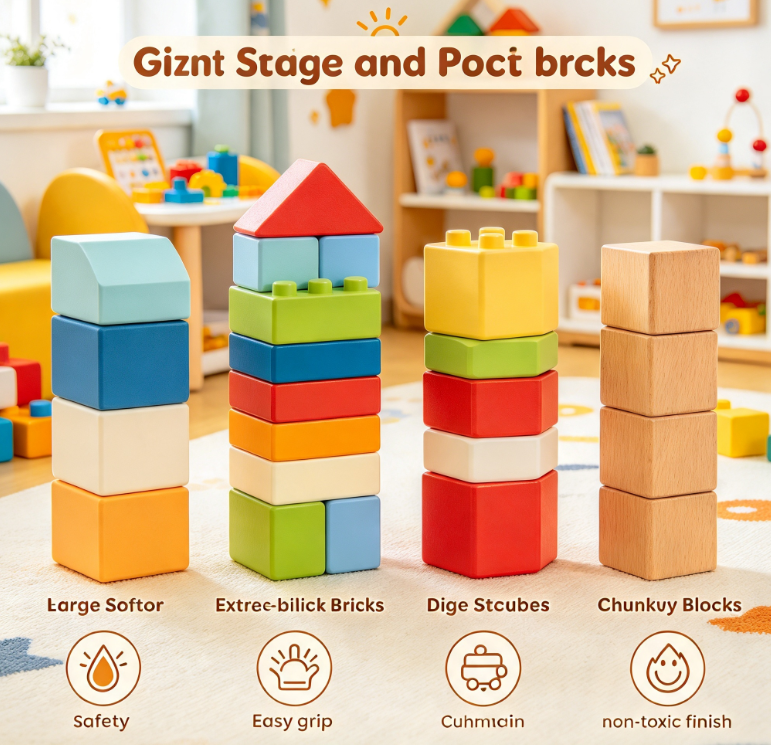
Which Giant Building Blocks Are Best for Toddlers? How to Choose, Test, and Play Safely
A toddler does three things with a new block. They look at it, bang it on the floor, and put it in their mouth. Usually in that order, and usually within ten seconds.
Kids & Toddlers Bricks
Best Wooden Building Blocks for Toddlers: How to Choose and Use Them
Wooden blocks are the oldest building toy in most homes, and they still earn their spot. No batteries. No app. No pieces that only work one way.
Kids & Toddlers Bricks
How to Choose the Best Magnetic Building Blocks for Toddlers
Your toddler stacks three tiles. The tower wobbles, then falls. They laugh and start again. That loop is what magnetic blocks are good for.