
The LTE Framework: Building Blocks of LTE Architecture for Serious MOC Builders
Most brick builders skip planning. They dump pieces on the table, start stacking, and hope the structure holds. Sometimes it works. Often it doesn't. The wall bows, the proportions drift, and the finished model looks like a first draft.
There's a better way. It's a planning system built on three layers: Layers, Technique, and Expression. Together they form the building blocks of lte architecture — a repeatable framework for designing architectural MOCs that stand straight, read as real structures, and hold up under scrutiny.
This guide breaks down each layer of the LTE method. You'll learn how to plan a model in structural tiers, how to sequence your techniques for maximum stability, and how to reserve your creative energy for the details that matter. This is a system, not a set of tips. Follow it and your builds get faster, sharper, and more consistent.
Let's break it down.
What "LTE" Means for Brick Architecture
Network engineers use the term LTE for a layered communication standard. Each layer does one job, connects cleanly to the next, and the whole system runs because the parts are separated by function.
Architectural brick building works the same way. The building blocks of lte architecture borrow that logic and apply it to physical construction:
- L — Layers. The structural tiers of your model, from foundation to roofline.
- T — Technique. The connection methods that hold each layer together.
- E — Expression. The design choices that make the model yours.
Separate these three, and every problem becomes easier to solve. A weak wall is a Technique problem. A model that reads as a box is an Expression problem. A build that collapses under its own weight is a Layers problem. When you know which layer is failing, you know exactly what to fix.
This is the core value of a modular framework. You stop treating a build as one giant task and start treating it as three connected systems.
Key point: LTE splits a build into three functional layers — Layers, Technique, Expression — so problems are easy to isolate and fix.
Layer 1 — Layers: Plan the Structural Tiers First
Every building has a vertical logic. Foundation carries structure. Structure carries floors. Floors carry the roof. Skip a tier or reverse the order, and the whole model suffers.
The first of the building blocks of lte architecture is planning these tiers before you place a single piece.
Define Your Vertical Stack
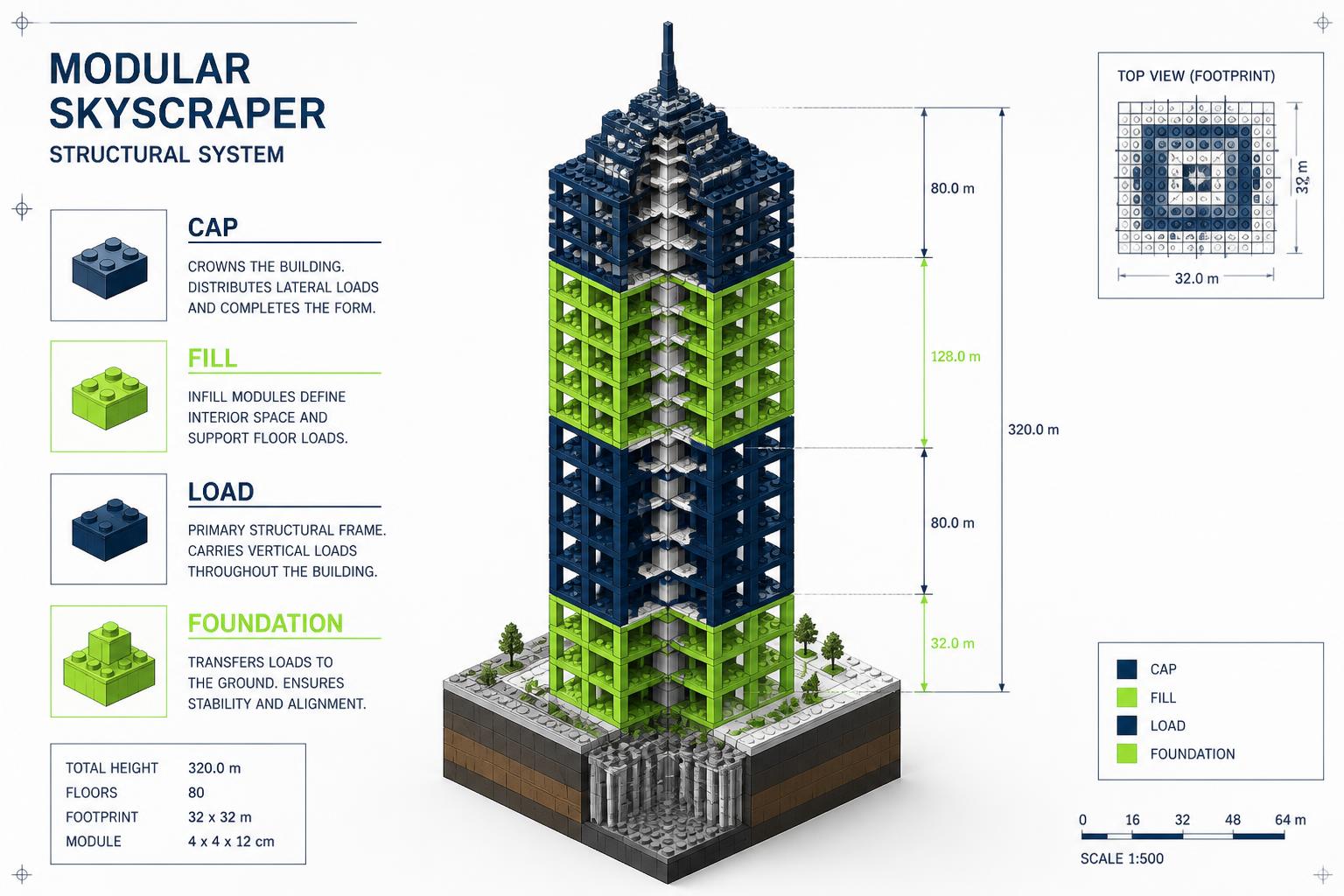
Break your building into horizontal bands. A standard structure has four:
- Foundation tier. The baseplate and ground level. Carries all weight above.
- Load tier. The primary walls and columns. The structural skeleton.
- Fill tier. Floors, interior sections, and secondary walls.
- Cap tier. The roofline, cornices, and crown details.
Sketch these bands on paper before you build. Note the height of each in bricks and plates. This is your vertical map, and it prevents the most common MOC failure: running out of vertical space for the roof because the lower tiers ate the budget.
Assign Piece Quality by Tier
Not every brick belongs everywhere. Match piece quality to tier function:
| Tier | Piece Priority | Reasoning |
|---|---|---|
| Foundation | Solid, common bricks | Hidden, load-bearing, no detail needed |
| Load | Tight-clutch bricks | Structural integrity is critical |
| Fill | Mixed quality | Partially hidden, moderate stress |
| Cap | Best-fitting, best-looking | Fully visible, defines the silhouette |
This tiered approach saves money and improves results. You spend your premium pieces where they show, and your budget pieces where they don't. When you're stocking parts by tier, a well-organized supplier makes the job easier — browse structural bricks and detail parts at the BrickHobby collection to fill each tier without over-ordering.
Build From the Bottom Up, Design From the Top Down
Here's the counterintuitive part. You build bottom-up, but you design top-down.
Start your design with the silhouette you want — the Cap tier. Then work backward. If the roof needs a specific width, the Load tier walls must support that width. If the walls need that footprint, the Foundation must span it. Designing top-down means every tier serves the final look. Building bottom-up means every tier has support before you add weight.
Key point: Map your model into four structural tiers, assign piece quality to each, and design top-down while building bottom-up.
Layer 2 — Technique: Sequence Your Connection Methods

A tier plan tells you what to build. Technique tells you how to hold it together. This is the second of the building blocks of lte architecture, and it's where most builds either lock solid or fall apart.
The key insight: techniques have an order. Some methods must go in before others, or you'll have to tear down to add them.
The Technique Stack
Think of your connection methods as a stack, applied in sequence:
- Base locking. Anchor the foundation tier with overlapping plates that span the full footprint. Do this first — it's impossible to add later without rebuilding.
- Vertical binding. As you raise the Load tier, run binding plates every four to six brick courses. These tie the wall into a single unit and stop bowing before it starts.
- Cross-bracing. At corners and long spans, interlock bricks across the joint. This transfers load sideways and keeps large walls rigid.
- Sideways integration. For any facade detail that faces outward, plan your sideways-building points before you seal the wall. Studs-facing-out connections must be built in, not added on.
Why Sequence Matters
Miss a technique in sequence and you pay for it later. Forget vertical binding on course four? You'll notice the bow at course twenty — and by then, fixing it means dismantling sixteen courses.
This is the modular advantage again. Each technique connects to the tier below it. Get the sequence right and the whole structure integrates cleanly, layer by layer.
Plan Your Weak Points
Every mixed-technique build has stress points. Identify them before you build:
- Tier transitions. Where one structural band meets the next.
- Overhangs. Any section that extends past its support.
- Span midpoints. The center of any long horizontal run.
- Attachment joints. Where separate sub-assemblies connect.
Mark these on your vertical map. Reinforce them as you reach each one, not after the fact. For builders working through complex connection methods, the technique guides and part references at BrickHobby's resources help you plan the right piece for each stress point.
Key point: Techniques follow a sequence — base locking, vertical binding, cross-bracing, sideways integration. Apply them in order or rebuild later.
Layer 3 — Expression: Reserve Creativity for What's Seen
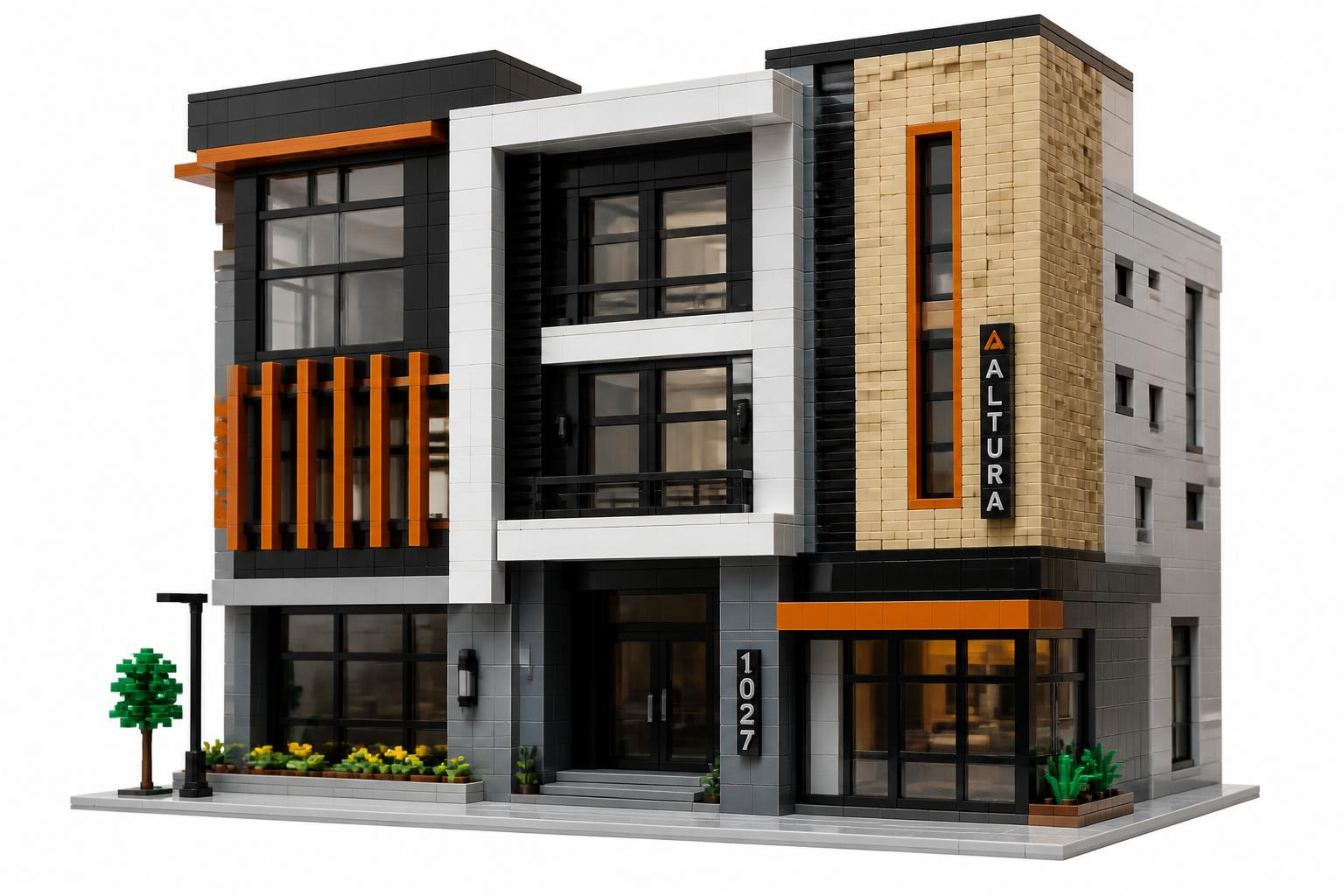
The first two layers keep your model standing. The third makes it worth looking at. Expression is the final component of the building blocks of lte architecture, and it's where your design voice lives.
The principle here is focus. Structure is invisible once the model is done. Expression is all anyone sees. So concentrate your creative energy on the visible surface, not the hidden skeleton.
The Expression Budget
Treat creativity as a budget. You have limited time and premium pieces. Spend them where they show:
- The primary facade. The face people see first gets the most detail.
- The silhouette. The roofline and outline define recognition. Invest here.
- Eye-level features. Doors, entrances, and ground-floor details sit where viewers focus.
- Signature elements. The one or two features that define your building's character.
Everything else — the back wall, the interior structure, the underside — gets functional treatment. No one photographs the back.
Techniques That Carry Expression
A few methods deliver the most visual return:
- Surface texture variation. Mix smooth tiles, standard bricks, and textured elements across one facade to create depth and shadow.
- Recessed and projected planes. Push some sections back, pull others forward. Flat facades read as toys. Layered ones read as buildings.
- Custom color accents. A restrained accent color draws the eye to signature features.
- Micro-detailing. Small, correctly scaled elements — railings, mullions, trim — sell the realism at close range.
Leave Room to Iterate
Expression is the one layer you should expect to redo. Structure gets locked early. Detail gets refined. Build your facade so the top-layer detail tiles lift off without disturbing the structure beneath. This lets you swap, adjust, and improve the visible surface without touching the skeleton.
This modularity is the payoff of the whole LTE approach. Because your layers are separated by function, you can perfect the Expression layer without risking the Layers and Technique work underneath.
Key point: Spend your creative budget on the visible surface, build detail to be removable, and iterate on Expression without disturbing structure.
Putting the Three Layers Together
The LTE framework works because the three layers stay separate but connect cleanly. Here's how a full build flows through the system.
The Full Workflow
- Design top-down. Start with the silhouette you want (Expression goal), then map the four tiers backward to support it (Layers plan).
- Sketch the vertical map. Note tier heights, piece quality per tier, and marked stress points.
- Build bottom-up. Lay the foundation, then raise each tier in order.
- Apply techniques in sequence. Base locking, then vertical binding, then cross-bracing, then sideways integration — each as you reach the right course.
- Add Expression last. Cap the structure, then layer on removable detail across the visible surfaces.
- Iterate the surface. Refine the Expression layer until the model reads exactly as intended.
Why This Beats Freestyle Building
Freestyle building mixes all three layers at once. You're solving structure, connection, and detail simultaneously — which is why freestyle builds stall. The LTE method separates the problems. You solve one layer at a time, and each solved layer supports the next.
For adult hobbyists building complex MOCs — see more guides in our Architecture & Landmarks blog, this separation is the difference between a model you finish and a model you abandon. A modular framework turns an overwhelming project into three manageable stages.
Serious builders track their tier plans and technique sequences across projects, building a personal system that improves with every model. To plan your next architectural MOC with the right parts for each layer, explore the full range at BrickHobby.
Key point: Design top-down, build bottom-up, sequence your techniques, and finish with removable Expression — one layer at a time.
Scaling the Framework to Larger Builds
The LTE method scales. A small facade uses the same three layers as a full cathedral. The difference is how you handle size.
Break Large Builds Into Modules
For any build too big to move in one piece, split it into modules — each a complete LTE unit with its own Layers, Technique, and Expression. Then connect the modules.
- Module boundaries at tier transitions. Split where structural bands meet for the cleanest joins.
- Standard connection points. Design matching stud interfaces between modules so they lock and unlock cleanly.
- Independent Expression. Detail each module separately, then unify the color and texture logic across the whole build.
This modular approach lets you build a large structure across multiple sessions, transport it in sections, and store it disassembled. It's the same logic that makes network architecture reliable — self-contained units that connect through standard interfaces.
Match Modules Across a Collection
Once you standardize your connection points, modules become interchangeable. A tower module from one build can join a street scene from another. Builders who commit to the LTE framework end up with a library of compatible modules that combine into new layouts.
Key point: Split large builds into self-contained LTE modules with standard connection points, then combine them across projects.
Summary
The building blocks of lte architecture give you a repeatable framework for designing architectural MOCs:
- Layers — Plan your model in four structural tiers and assign piece quality to each.
- Technique — Apply connection methods in sequence: base locking, vertical binding, cross-bracing, sideways integration.
- Expression — Spend your creative budget on the visible surface and build detail to be removable.
Design top-down, build bottom-up, and solve one layer at a time. For larger projects, split the build into self-contained modules that connect through standard interfaces.
Freestyle building forces you to solve structure, connection, and detail all at once. The LTE framework separates them, so each solved layer supports the next. The result: models that stand straight, read as real architecture, and improve with every build.
Start with your next model. Map the four tiers, sequence your techniques, and reserve your best pieces for what's seen.
Frequently Asked Questions
What are the building blocks of LTE architecture in brick building?
They're a three-layer planning framework — Layers, Technique, and Expression — applied to architectural brick models. Layers covers the structural tiers from foundation to roofline. Technique covers the connection methods that hold each tier together in the right sequence. Expression covers the visible design details that give a model its character. Separating these three lets you plan, build, and troubleshoot complex MOCs one layer at a time instead of solving everything at once.
How is this different from just following build instructions?
Instructions tell you what piece goes where for one specific model. The LTE framework teaches you the underlying logic so you can design your own structures. Instead of memorizing steps, you learn to plan structural tiers, sequence your techniques, and focus your creativity on the visible surface. It's a system you apply to any architectural build, official or original, at any scale.
Do I need advanced skills to use the LTE framework?
No. The framework actually makes complex builds more approachable by breaking them into three manageable stages. Beginners benefit most, because separating structure from detail removes the overwhelm that stalls first MOCs. Start with a small facade using the four-tier plan, apply the technique sequence, and add removable detail last. As you build more, the framework becomes second nature and scales to larger projects.
How do I apply this to a very large model?
Split the build into self-contained modules, each a complete LTE unit with its own tiers, techniques, and detail. Place module boundaries where structural bands meet, and design matching stud connection points so modules lock together cleanly. This lets you build across multiple sessions, transport the model in sections, and store it disassembled. Standardized connection points also make modules interchangeable across different builds.
What parts should I stock to build this way?
Stock by tier. For foundation and hidden structure, keep common solid bricks and plenty of plates for base locking and vertical binding. For the load tier, prioritize tight-clutch bricks for structural integrity. For the visible Expression layer, keep smooth tiles, textured elements, sideways-building bricks, and accent colors for facade detail. Buying by tier prevents over-ordering and ensures you have the right piece for each layer when you reach it.
Ready to build this yourself?
BrickHobby sells high-quality LEGO-alternative building block sets — the same brick standard, a fraction of the price. Browse our in-stock sets and simply contact our customer service team to place your order; we will confirm availability, pricing and worldwide shipping for you.
Keep reading

Architecture & Landmarks
Build Impressive Landmarks with Building Blocks Landmark 5 Sets
A hobbyist and family guide to building blocks landmark 5 sets — how to choose, sort, and build display-quality Eiffel Tower, Colosseum, and Taj Mahal models with BrickHobby as a LEGO alternative.
Architecture & Landmarks
How to Build Impressive Structures with Architecture Wooden Building Blocks
A step-by-step guide for hobbyists and families: how to choose a set, plan, sort, and build display-quality architecture models with wooden-style building blocks.

Architecture & Landmarks
How to Build Stunning Architectural Models with ABB Architecture Building Blocks
ABB architecture building blocks let hobbyists turn a love of buildings into display-worthy models. A complete builder's guide — planning, execution, choosing quality bricks, and showcasing the finished piece.