
How to Recreate Famous Architectural Styles with Building Blocks
How to Recreate Famous Architectural Styles with Building Blocks
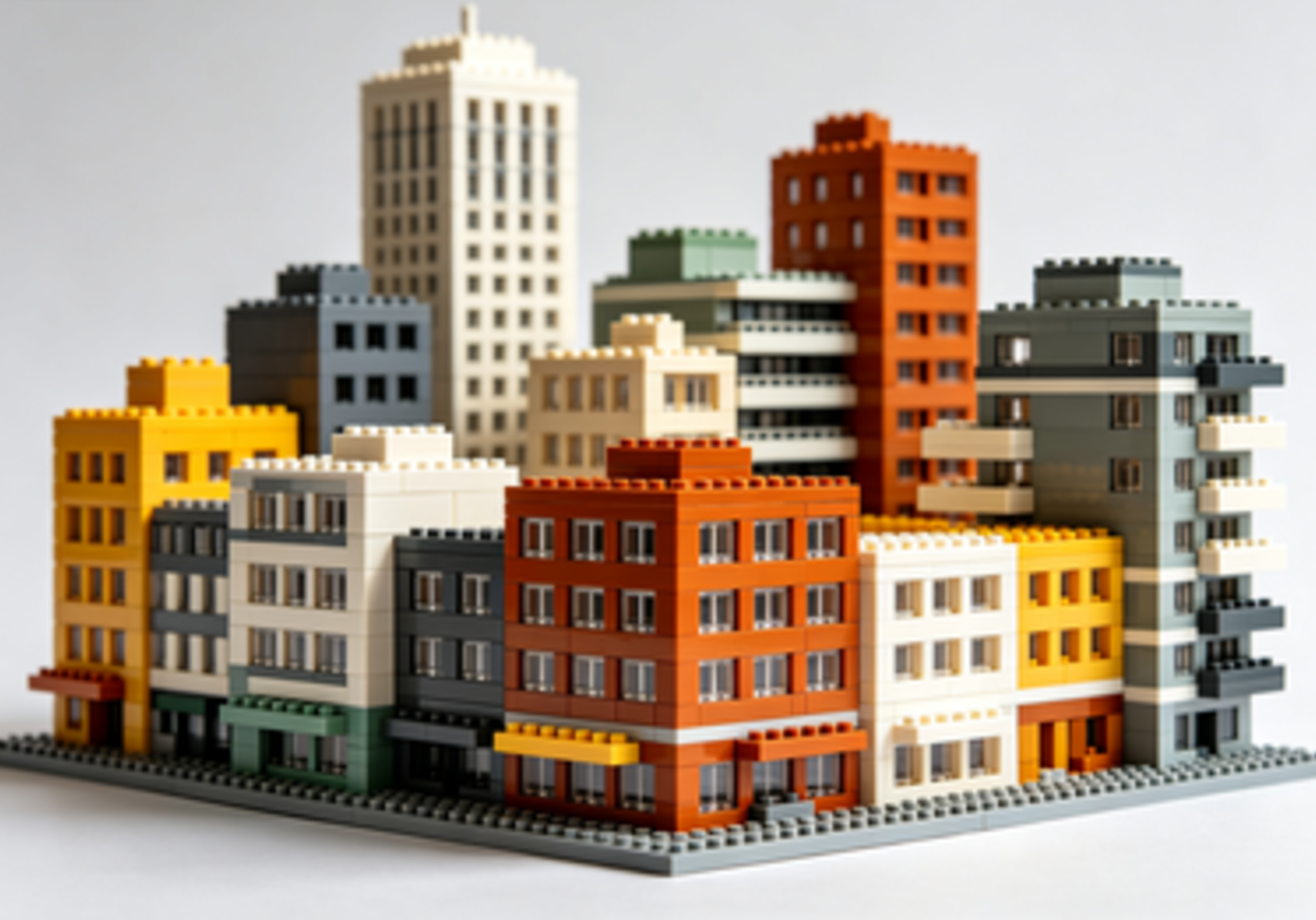
Every architectural style has a fingerprint. Gothic has the pointed arch. Art Deco has the stepped crown. Brutalism has the raw concrete slab. Learn to spot those signatures, and you can build any of them in brick.
This guide takes a different approach from a standard build tutorial. Instead of teaching you scale and structure, it teaches you style. You'll learn how to read the defining features of four major architectural movements — then translate each one into specific brick techniques. Master this, and your models stop looking generic. They start looking like they belong to a period, a place, and a purpose.
That's the real skill in building blocks architecture: not just stacking bricks, but capturing the character of a style. Let's decode four of them.
Why Style Matters More Than Detail
A model can have a thousand tiny details and still miss the mark. If the proportions and signature features are wrong, the eye knows something is off — even when the viewer can't say why.
Style is the shortcut. Nail three or four style-defining features and your model reads correctly at a glance. A pointed arch says "Gothic" instantly. A flat cantilevered roof says "Modernist." You don't need every window and cornice. You need the right ones.
Here's how to work style-first:
- Identify the movement. Name the style before you build. Gothic? Art Deco? You can't recreate what you haven't named.
- List the signature features. Every style has three to five hallmarks. Find them.
- Translate each into brick. Match each feature to a specific building technique.
- Prioritize the signatures. Spend your best parts and effort on the features that define the style.
BrickHobby stocks parts sorted by shape and angle, which makes style-specific building far easier. Browse the range at BrickHobby before you start a themed build.
Gothic: Height, Points, and Light
Gothic architecture reaches up. Cathedrals, churches, and old universities share a vertical obsession — everything points to the sky. The style ran from the 12th to the 16th century and still defines skylines across Europe.
The Signature Features
- Pointed arches. The single most recognizable Gothic element. Never rounded — always coming to a point.
- Ribbed vaults and tall windows. Narrow, vertical, often grouped.
- Flying buttresses. External supports that arc away from the walls.
- Spires and pinnacles. Sharp vertical peaks crowning the structure.
- Ornamental tracery. Delicate stone patterns inside window frames.
Translating Gothic Into Brick
The pointed arch is your priority. Build it with two curved slope pieces leaning toward each other, meeting at a peak. Use hinge plates at the base to set the angle. A rounded arch reads as Roman or Norman — keep yours sharp.
Tall windows work best in vertical clusters. Stack thin transparent panels in narrow columns. Leave dark tile between them to suggest stone mullions. Group three windows together for the classic Gothic rhythm.
Flying buttresses are the showstopper. Build angled arms of brick that reach from the upper wall down to separate outer columns. They carry no real weight in your model, but they define the silhouette. Space them evenly along the nave.
Spires are cones and stacked angled pieces narrowing to a point. Build them tall — Gothic always exaggerates height. A spire that looks slightly too tall is usually right.
For texture, mix two or three shades of gray. Real cathedral stone is weathered and uneven. Flat, single-color walls kill the effect.
Art Deco: Geometry, Symmetry, and Glamour
Art Deco defined the 1920s and 1930s. The Chrysler Building. The Empire State Building. Cinemas, hotels, and ocean liners. It's bold, symmetrical, and unapologetically decorative.
The Signature Features
- Stepped setbacks. Buildings that narrow as they rise, in clean stages.
- Vertical emphasis. Strong upward lines, often in metal or contrasting color.
- Sunburst and chevron motifs. Geometric decoration, repeated.
- Symmetry. Nearly always mirror-image balanced.
- Ornamental crowns. Elaborate, sculptural tops — the Chrysler spire is the icon.
Translating Art Deco Into Brick
Stepped setbacks are the backbone. Build your tower in stacked blocks, each smaller than the one below. Keep the steps clean and symmetrical. Use tiles on each setback ledge for a smooth, finished edge. This tiered shape alone signals Art Deco.
Vertical lines run the full height. Place thin bricks or tiles turned on edge in unbroken columns up the facade. Use a contrasting color — gold, silver, or dark trim against a lighter wall. This is what gives Art Deco its striped, elegant look.
The crown is where you go all in. Stack narrowing arches or radiating spikes to build a sculptural top. The Chrysler Building's crown is a series of stacked arches — recreate it with curved slopes in decreasing rings, each smaller than the last.
Geometric motifs work through SNOT (studs not on top) building. Turn small plates sideways to create chevron and sunburst patterns on flat facade panels. Keep the patterns symmetrical and repeated.
Color discipline matters here. Art Deco leans on two-tone schemes — a light body with metallic or dark accents. This clean palette is central to good building blocks architecture in this style. Sort your accent color into a separate tray so it stays consistent across the whole build.
Detailed slope and tile assortments for facade work are available at BrickHobby, sorted so you can pull matching pieces fast.
Brutalism: Mass, Texture, and Raw Form
Brutalism is love-it-or-hate-it architecture. Concrete government buildings, universities, and housing blocks from the 1950s through the 1970s. It's heavy, bold, and honest about its materials. The name comes from béton brut — French for raw concrete.
The Signature Features
- Massive concrete forms. Big, blocky, monolithic shapes.
- Repetitive modular units. The same window or panel repeated across the whole facade.
- Exposed texture. Rough surfaces that show the material.
- Geometric boldness. Cantilevers, deep recesses, sharp angles.
- Monochrome palette. Almost always gray.
Translating Brutalism Into Brick
Massive forms mean building in large, simple blocks. Resist the urge to add fussy detail. Brutalism's power comes from scale and simplicity. Build big, clean rectangular volumes and let them dominate.
Modular repetition is easy and satisfying in brick. Build one window or balcony unit, then repeat it dozens of times across the facade. This repetition is the essence of the style — and a huge time-saver. Perfect one module, copy it everywhere.
Texture is the challenge. Real Brutalist concrete has a rough, board-marked surface. Recreate this by mixing studded bricks with textured or grille pieces. Avoid smooth tiles — you want a rough, uneven face. A patchwork of slightly different grays adds to the raw look.
Cantilevers define the silhouette. Build sections that jut out over empty space, supported from behind by a strong internal core. A heavy upper block hanging over a recessed base is pure Brutalism. Reinforce the connection so it holds.
Keep the palette locked to gray. One or two shades, no more. Brutalism's discipline is its strength.
Modernist: Clean Lines, Glass, and Openness
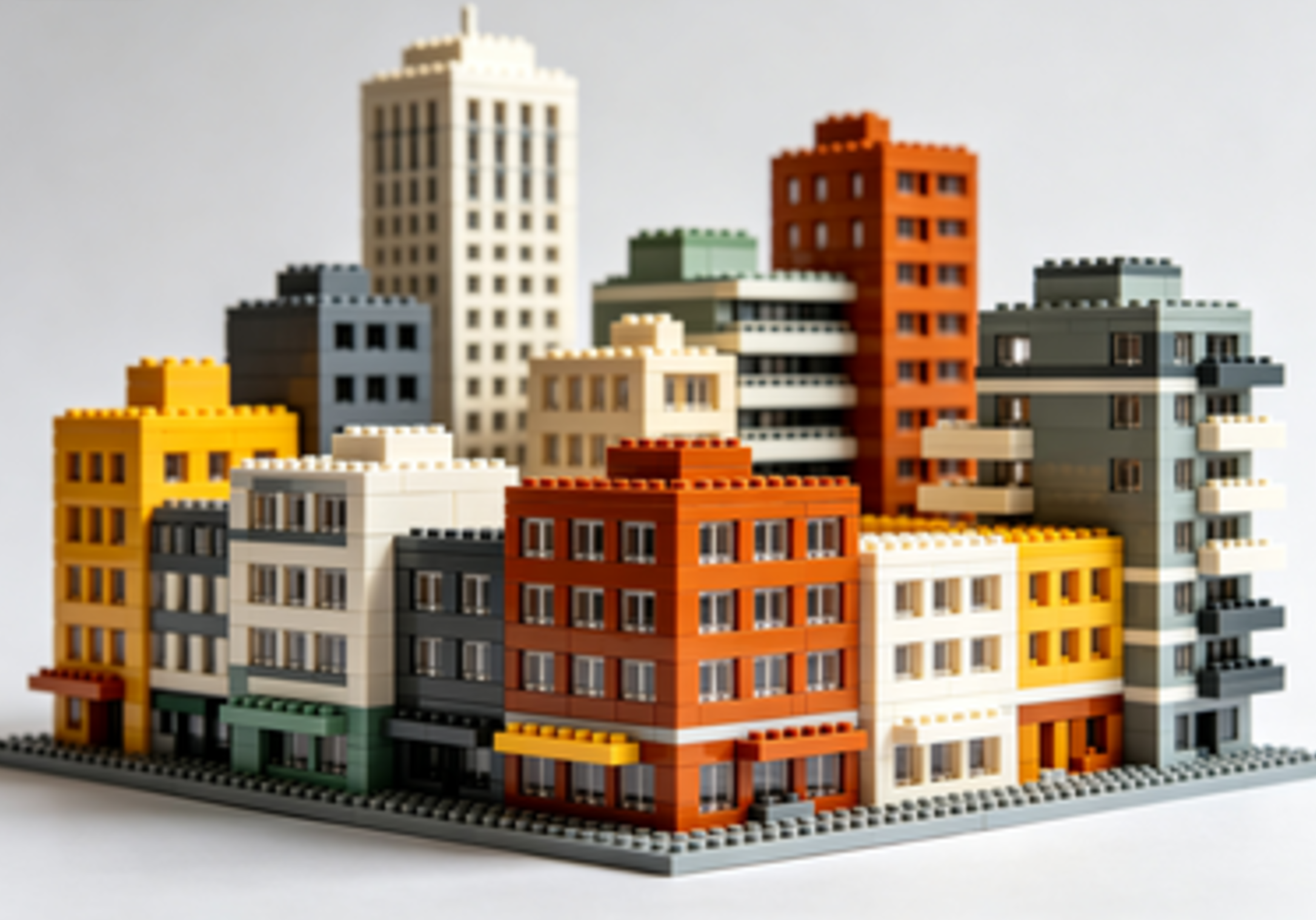
Modernism stripped away decoration. "Form follows function." Think Mies van der Rohe, Le Corbusier, and the glass towers of the mid-20th century. Flat roofs, open floor plans, and huge windows define it.
The Signature Features
- Flat roofs. No slopes, no crowns — clean horizontal tops.
- Horizontal emphasis. Long, low lines rather than vertical thrust.
- Glass curtain walls. Entire facades of glass.
- Open, minimal form. No ornament. Function on display.
- Pilotis. Buildings raised on slim columns, leaving open space below.
Translating Modernist Into Brick
Flat roofs are simple — cap your structure with a clean layer of tiles. No slopes, no spires. The flat top is a defining feature, so keep it crisp with a smooth, tiled edge.
Horizontal lines run the width of the building. Use long tiles and plates laid end to end to create unbroken horizontal bands. This low, stretched look is the opposite of Gothic's vertical reach.
Glass curtain walls are the Modernist signature. Build entire facades from transparent panels in a clean grid. Use thin frames between them — light gray or black. The more glass, the more Modernist it reads. This heavy use of transparent parts is a hallmark of Modernist building blocks architecture, so stock up on clear panels before you begin.
Pilotis lift the building. Build slim columns to raise the main structure off its base, leaving open space underneath. This floating effect is a Le Corbusier trademark and instantly signals the style.
Modernism rewards restraint. Every piece should have a purpose. If a detail is decorative, cut it. The clean, minimal look is the whole point.
How to Mix Styles or Invent Your Own
Once you can read and build individual styles, you can combine them or design something new. This is where the hobby gets truly creative.
Study transitional buildings. Many real structures blend styles — Neo-Gothic skyscrapers, Art Deco with Modernist elements. Look at how real architects merged features, then copy their logic.
Keep one style dominant. When mixing, let one movement lead and use the other for accents. A mostly Modernist tower with an Art Deco crown works. An even 50/50 split usually looks confused.
Match features to function. In your own designs, let the building's purpose guide the style. A civic building suits Brutalist weight. A luxury hotel suits Art Deco glamour. Function and style should agree.
Test on a small scale first. Before committing to a full build, mock up a single facade section in each candidate style. Compare them side by side. This saves hours of rebuilding.
Share your themed builds with the online building community. Style-based models spark great discussion — other builders love identifying the movement and suggesting refinements. Post progress shots, ask for feedback, and study what others have built. Community input sharpens your eye faster than building alone.
For your next themed project, BrickHobby offers style-specific parts and loose bricks sorted for detailed builds. No Customs or Duty Fees on orders — the price at checkout is the final amount you pay. See the full selection at BrickHobby.
Quick Reference: Style to Brick
Keep this handy when planning a build.
- Gothic — pointed arches, tall clustered windows, flying buttresses, spires. Weathered gray.
- Art Deco — stepped setbacks, vertical lines, sculptural crown, geometric motifs. Two-tone with metallic accents.
- Brutalism — massive blocks, repeated modules, rough texture, cantilevers. Monochrome gray.
- Modernist — flat roofs, horizontal lines, glass curtain walls, pilotis. Clean and minimal.
Match your subject to its movement, hit the signature features, and your model will read correctly every time.
Wrapping Up
Recreating architectural styles is the most rewarding path in the hobby. It turns brick building into a study of design history — Gothic height, Art Deco glamour, Brutalist mass, Modernist clarity. Each one has a fingerprint you can learn to read and rebuild.
Start by naming the style. List its three to five signature features. Translate each into a brick technique. Prioritize the features that define the movement, and keep your palette disciplined. Do that, and your models won't just look like buildings — they'll look like specific buildings from a specific era.
Pick a style that speaks to you, gather your parts, and start building. A city of architectural history is waiting on your shelf.
Frequently Asked Questions
Which architectural style is easiest for beginners to build?
Modernist is the most beginner-friendly. Its clean lines, flat roofs, and minimal ornament mean fewer complex techniques to learn. You build simple rectangular volumes, add glass panels in a grid, and cap it with a flat roof. Brutalism is a close second, since its repeated modular units let you master one small section and copy it across the whole facade. Save Gothic and Art Deco for later — their pointed arches and sculptural crowns take more practice.
How do I make a pointed Gothic arch out of building blocks?
Use two curved slope pieces leaning toward each other so they meet at a point at the top. Set the base angle with hinge plates so you can adjust the sharpness. The key is keeping the arch pointed, not rounded — a rounded arch reads as Roman or Norman rather than Gothic. For larger arches, stack multiple curved pieces on each side to increase the height while keeping the peak sharp.
What parts do I need most for style-based building blocks architecture?
It depends on the style, but a few part types cover most needs. Curved slopes handle arches, spires, and Art Deco crowns. Transparent panels create Modernist glass walls and Gothic windows. Textured and grille bricks give Brutalist concrete its rough surface. Plenty of tiles let you build clean edges, flat roofs, and horizontal Modernist lines. Sorting these by shape before you build makes style work far faster.
How can I tell which architectural style a real building belongs to?
Look for the signature features. Pointed arches, spires, and vertical height point to Gothic. Stepped setbacks, symmetry, and sculptural crowns mean Art Deco. Raw concrete, repeated modules, and heavy blocky forms indicate Brutalism. Flat roofs, glass walls, and horizontal lines signal Modernism. Most buildings fit one dominant style, though some blend two. Once you learn the three to five hallmarks of each movement, identification becomes quick.
Can I combine two architectural styles in one model?
Yes, and many real buildings do exactly that. The trick is letting one style dominate while the other provides accents — a mostly Modernist tower with an Art Deco crown, for example. Keep the split uneven; a clean 70/30 mix reads as intentional design, while an even split often looks confused. Study real transitional buildings to see how architects blended movements, then apply the same logic to your own build.
Ready to build this yourself?
BrickHobby sells high-quality LEGO-alternative building block sets — the same brick standard, a fraction of the price. Browse our in-stock sets and simply contact our customer service team to place your order; we will confirm availability, pricing and worldwide shipping for you.
Keep reading
Architecture & Landmarks
Build Impressive Landmarks with Building Blocks Landmark 5 Sets
A hobbyist and family guide to building blocks landmark 5 sets — how to choose, sort, and build display-quality Eiffel Tower, Colosseum, and Taj Mahal models with BrickHobby as a LEGO alternative.
Architecture & Landmarks
How to Build Impressive Structures with Architecture Wooden Building Blocks
A step-by-step guide for hobbyists and families: how to choose a set, plan, sort, and build display-quality architecture models with wooden-style building blocks.
Architecture & Landmarks
How to Build Stunning Architectural Models with ABB Architecture Building Blocks
ABB architecture building blocks let hobbyists turn a love of buildings into display-worthy models. A complete builder's guide — planning, execution, choosing quality bricks, and showcasing the finished piece.